


A Tale of Two Sun-Gazers
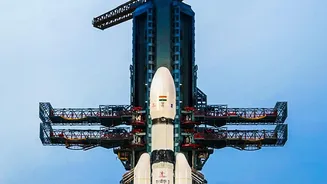
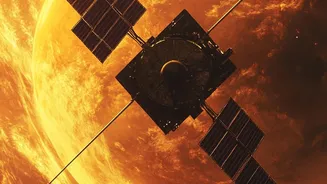
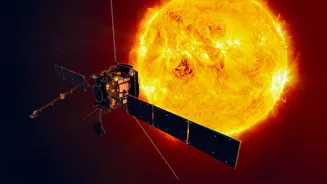
At the heart of this achievement are two of the most sophisticated solar observatories ever launched. On one side is India’s pride, Aditya-L1, stationed at the first Lagrange point (L1) roughly 1.5 million kilometres from Earth. From this vantage point,
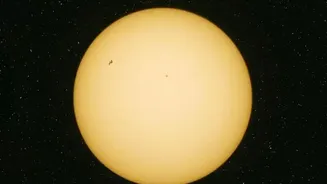
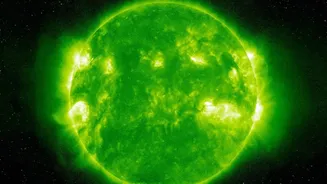
it enjoys an uninterrupted view of the Sun. Launched by the Indian Space Research Organisation (ISRO), Aditya-L1 is a comprehensive solar laboratory, equipped with seven distinct payloads designed to study everything from the Sun’s visible surface, the photosphere, to its outermost layer, the corona. Its mission is to unlock the secrets behind coronal heating, solar wind acceleration, and the powerful eruptions that define our star’s behaviour.On the other side is the European Space Agency’s (ESA) Proba-3, a mission of technical marvels. Proba-3 is not a single spacecraft but a pair of satellites flying in perfect formation, separated by 150 metres. One satellite, the 'Occulter', blocks the bright face of the Sun, while the other, the 'Coronagraph', studies the Sun’s faint atmosphere. Together, they create a near-perfect artificial solar eclipse, allowing scientists to view the inner corona—the birthplace of solar storms—with a clarity never before possible.
Seeing the Sun Like Never Before
Individually, both missions are powerful. Together, they are revolutionary. The key to this partnership lies in their complementary capabilities. While Aditya-L1’s instruments, such as the Visible Emission Line Coronagraph (VELC) and the Solar Ultraviolet Imaging Telescope (SUIT), provide a wide, contextual view of the entire solar disk and its atmosphere, they can be blinded by the Sun's overwhelming glare when trying to observe the regions closest to its surface. This is precisely where Proba-3 excels. By creating a precise, long-duration artificial eclipse, Proba-3’s advanced coronagraph can peer into this mysterious, super-hot region where solar wind originates and coronal mass ejections (CMEs) begin their journey across the solar system. This synergy allows scientists to connect the dots in real-time. Aditya-L1 can spot the warning signs of an eruption on the Sun's surface, and Proba-3 can capture the event itself, in high-resolution detail, the moment it escapes the Sun's grasp. It’s like having one lookout watching for the spark and another zoomed in on the resulting explosion.
Decoding a Historic Solar Outburst
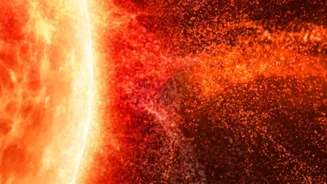
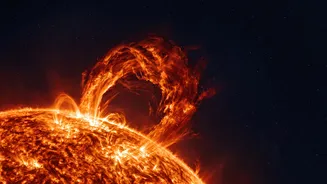
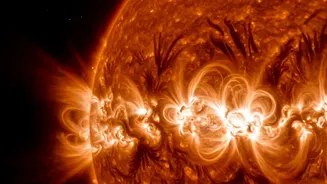
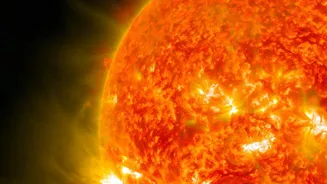
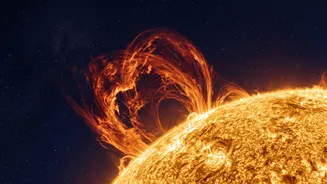
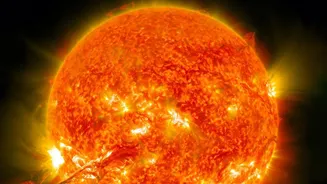
The first joint analysis focused on a significant solar outburst that occurred earlier this month. Data from Aditya-L1’s instruments first detected a cascade of activity on the Sun's surface—a complex reorganisation of magnetic fields that signalled an impending eruption. This gave scientists an invaluable heads-up. As predicted, a massive cloud of plasma, a coronal mass ejection, began to billow outwards. Almost simultaneously, the Proba-3 duo, aligned and ready, captured the CME as it tore through the inner corona. The joint data provides a seamless, end-to-end movie of the event, from its magnetic roots deep within the Sun’s atmosphere to its explosive release into space. This holistic view is a game-changer for heliophysicists, who have long sought to bridge the observational gap between the solar surface and the outer corona. For the first time, they have the complete story of a CME’s birth.
Why This Matters for Us on Earth
While studying the Sun is a quest for fundamental knowledge, it has immensely practical implications. Solar outbursts like CMEs and solar flares are the primary drivers of 'space weather'. When aimed at Earth, these eruptions can have serious consequences. They can disrupt and damage satellites, which are critical for everything from GPS navigation and financial transactions to television broadcasts. They can interfere with radio communications and create surges in power grids, potentially leading to widespread blackouts. Astronauts in orbit are also exposed to harmful radiation during these events. By understanding precisely how and when these outbursts form, scientists can significantly improve their space weather forecasting models. This joint analysis by Aditya-L1 and Proba-3 is a monumental step towards creating a more reliable early-warning system, giving us the time needed to protect our vital infrastructure both in orbit and on the ground.