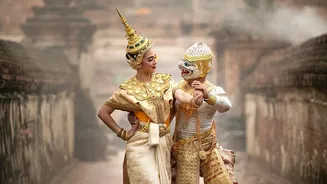








The Ramayana’s grand narrative is held together by more than just its central figures. Beyond Ram, Sita, and Hanuman lies a rich tapestry of characters whose stories of sacrifice, wisdom, and quiet courage are essential to the epic's soul.
Urmila: The Sacrifice of Silence
While Lakshman
chose exile to serve Ram and Sita, his wife Urmila made a sacrifice of a different, quieter kind. She remained in Ayodhya, enduring fourteen years of separation from her newlywed husband. But her sacrifice was more profound than mere waiting. According to devotional traditions, Urmila took on Lakshman's share of sleep for the entire exile, allowing him to remain awake and vigilant in his duty to protect Ram and Sita. This act, known as Urmila Nidra, meant she slept through the fourteen years, denying herself not just her husband's company but a normal life. Her story is a powerful reminder that not all heroism is loud or visible; some of the greatest sacrifices are made in silence, without an audience or expectation of praise.
Mandodari: The Voice of Righteousness
As Ravan's chief queen, Mandodari was a figure of immense grace and wisdom within the court of Lanka. Described as beautiful, pious, and righteous, she was a constant voice of reason, repeatedly advising her husband to return the abducted Sita to Ram and abandon his path of adharma. Mandodari's pleas fell on deaf ears, as Ravan's ego and pride were too great. Her character offers a striking contrast to her husband, representing a moral compass within a kingdom defined by arrogance. On one occasion, she physically intervened to save Sita's life when a furious Ravan drew his sword. Mandodari’s tragedy is that of a righteous woman bound by loyalty to a man who refused to heed her wise counsel, ultimately witnessing the destruction she had long foretold.
Shanta: The Sister Who Paved the Way
Few know that Ram and his brothers had an elder sister named Shanta. Though not mentioned in Valmiki's core text, later scriptures and folk traditions tell her story. Born to King Dasharath and Kausalya, Shanta was given in adoption to Rompada, the childless king of Anga. Her life took another fateful turn when she married the sage Rishyashringa. It was this same sage who was later invited to Ayodhya by Dasharath to perform the Putrakameshti Yajna, the sacred fire ritual that resulted in the birth of Ram, Bharat, Lakshman, and Shatrughan. In this way, Shanta's life, though lived away from Ayodhya, became fundamentally linked to the arrival of her brothers and the unfolding of the entire epic. Her story is one of quiet acceptance and unseen but critical importance.
Jambavan: The Ancient, Wise Bear-King
Jambavan, the king of the bears, is one of the epic's most ancient and wisest figures. Created by Brahma himself, he was an immortal who had witnessed multiple avatars of Vishnu, including Vamana. In the Ramayana, his role is that of a sage counsellor and a powerful motivator. When the vanara army stood perplexed at the edge of the southern sea, unsure how to cross over to Lanka, it was Jambavan who reminded a self-doubting Hanuman of his dormant, divine powers. This pivotal moment of encouragement enabled Hanuman to make his legendary leap. Jambavan represents timeless wisdom, the importance of experience, and the power of a mentor to help a hero realize their own potential.
Ahalya : A Story Of A Curse And Grace
Ahalya's tale is one of the most poignant narratives of injustice and redemption in the epic. The beautiful wife of the sage Gautama, she was tricked by the god Indra, who disguised himself as her husband. Upon discovering the deception, Gautama, in a fit of rage, cursed Ahalya. While some versions say she was turned to a stone, the original Valmiki Ramayana states she was made invisible, forced to perform penance in isolation for ages. Many texts clarify Ahalya was innocent, a victim of Indra's deceit. Her long penance ended when Ram, during his exile, entered Gautama's ashram. The touch of his feet liberated her from the curse , restoring her form and dignity . Ram's act was not one of forgiveness but of grace , a recognition of her innocence and the correction of a long - held injustice .