



Mehrangarh Fort, Jodhpur
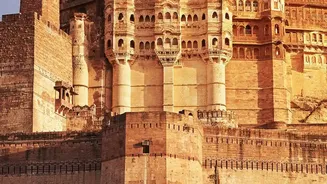
Towering 400 feet above the blue city of Jodhpur, Mehrangarh Fort is an awe-inspiring sight. Founded in 1459 by Rao Jodha, this citadel seems to emerge organically from its rocky perch. Its massive walls, which are up to 36 meters high in places, protect
a complex of intricate palaces, expansive courtyards, and a museum filled with royal artifacts. Known as the "Citadel of the Sun," its ramparts offer breathtaking panoramic views, making it clear why Rudyard Kipling described it as a palace built by Titans.
Chittorgarh Fort, Rajasthan
As the largest fort in India, Chittorgarh is less a single structure and more a 700-acre city on a hill. A UNESCO World Heritage site, it was the capital of the Mewar kingdom and a symbol of Rajput pride and resilience. The fort complex includes palaces, temples, and memorials, all enclosed by a perimeter wall that stretches for 13 kilometers. It has witnessed some of the most dramatic sieges in Indian history, including the infamous attack by Alauddin Khilji in 1303, and its stories of valor and sacrifice are legendary.
Kumbhalgarh Fort, Rajasthan
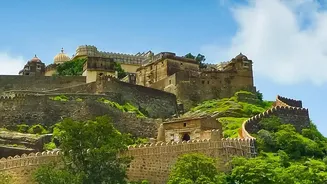
Often called the Great Wall of India, Kumbhalgarh is famous for its incredible perimeter wall that snakes through the Aravalli Hills for 36 kilometers, making it the second-longest continuous wall in the world. Built in the 15th century by Rana Kumbha, this formidable fort has seven massive gates and was considered virtually impregnable. The fort complex contains over 360 temples, both Hindu and Jain, and is also the birthplace of the legendary warrior Maharana Pratap. At its highest point sits the Badal Mahal, or "Palace of Clouds," offering stunning views of the surrounding range.
Jaisalmer Fort, Jaisalmer
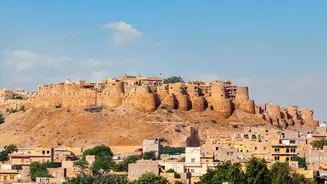
Rising from the heart of the Thar Desert, Jaisalmer Fort is a mesmerizing sight. Made of golden-yellow sandstone, it glows at sunrise and sunset, earning it the name "Sonar Quila" or the Golden Fort. What makes Jaisalmer truly unique is that it's one of the few "living forts" in the world, with a significant portion of the old city's population still residing within its walls. Built in 1156 by Rawal Jaisal, its winding narrow alleys are home to havelis, temples, shops, and restaurants, creating a vibrant atmosphere where history feels alive.
Golconda Fort, Hyderabad
Originally a mud fort built by the Kakatiya dynasty, Golconda was transformed into a massive granite fortress by the Qutb Shahi kings. Perched on a 120-meter-high granite hill, this fort was once the capital of the region and a major center for the diamond trade—it's believed that the famed Koh-i-Noor diamond passed through here. Golconda is renowned for its ingenious acoustics; a clap at the main gate can be heard at the highest point of the citadel, a feature designed for security. Its complex includes palaces, mosques, and an impressive water supply system.
Amer Fort, Jaipur
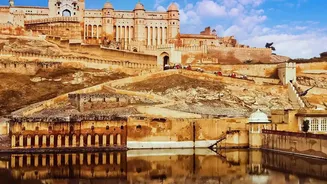
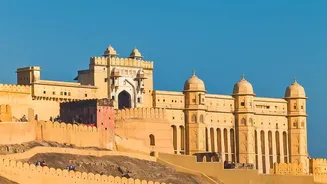
Located on a hill overlooking Maota Lake, Amer Fort is a stunning blend of Rajput and Mughal architectural styles. Constructed with red sandstone and marble, its opulent palace complex is laid out on four levels, each with its own courtyard. The fort was built by Raja Man Singh in the late 16th century and was the residence of the Rajput Maharajas. Visitors are captivated by the Diwan-e-Aam (Hall of Public Audience), the intricate mirror work of the Sheesh Mahal (Mirror Palace), and the artistic Ganesh Pol gateway.
Gwalior Fort, Madhya Pradesh
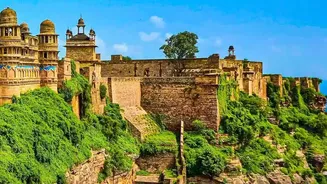
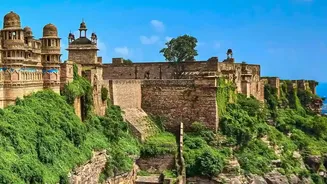
Hailed by the Mughal emperor Babur as "the pearl amongst the fortresses of Hind," Gwalior Fort has a history stretching back to at least the 6th century. Its strategic location on a steep, isolated sandstone hill made it one of India's most unconquerable forts. The vast complex has witnessed the rise and fall of numerous dynasties, including the Tomars, Mughals, and Scindias. It contains several remarkable structures, including the Man Mandir Palace with its vibrant blue-tiled exterior, the ancient Teli Ka Mandir temple, and massive rock-cut Jain sculptures.