



The Blackout Problem on the Moon
For decades, communicating with assets on the Moon has relied on a direct line-of-sight to Earth. If you can't see Earth, you can't talk to it. This creates significant blackouts, especially for missions on the lunar far side or in the heavily cratered
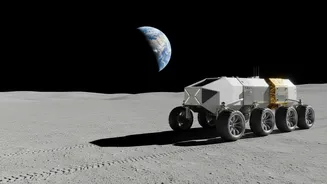
South Pole region. The Moon's topography, with mountains and deep craters like Shackleton—which is twice as deep as the Grand Canyon—can block signals. Furthermore, from the South Pole, Earth hangs low on the horizon, moving in and out of view, cutting off direct links for up to two weeks at a time. This limitation severely restricts where rovers can safely explore and where astronauts can establish long-term habitats, hindering scientific discovery and resource utilization.
LunaNet: An Internet for the Moon
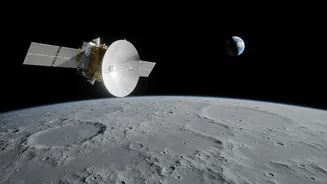
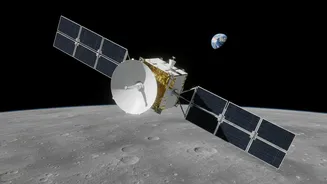
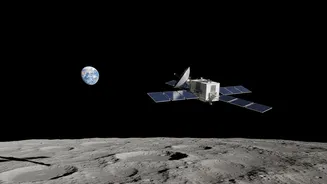
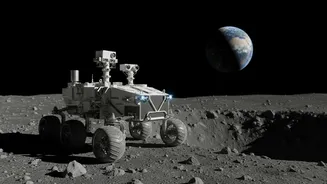
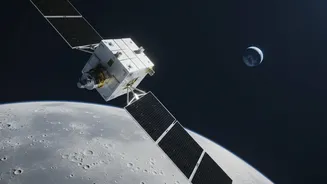
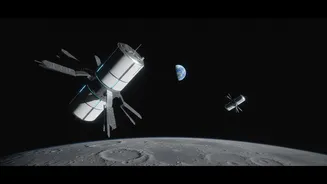
To solve this, NASA is designing LunaNet, an ambitious architecture that functions like a celestial internet service provider. Instead of relying on single-point connections, LunaNet will be a flexible network of interconnected nodes. These nodes can be orbiting satellites, surface stations, or even the missions themselves, all working together to relay data. This creates a 'network of networks' much like Wi-Fi routers and cell towers on Earth, allowing a rover in a crater to send data to an orbiting satellite, which then relays it back to Earth, bypassing the need for a direct link. This system, formally part of the Lunar Communications Relay and Navigation Systems (LCRNS) project, is designed to be scalable, allowing commercial and international partners to add their own nodes and expand the network's capabilities over time.
More Than Just a Phone Call Home
LunaNet’s services go far beyond simple communication. The architecture provides three core services: networking, science utilization, and—critically—Position, Navigation, and Timing (PNT). This means LunaNet will function like a lunar GPS, giving astronauts and robotic rovers the ability to determine their precise location and navigate autonomously without constant input from Earth. This is a game-changer for exploration, enabling rovers to traverse hazardous terrain and astronauts to operate with greater safety and independence. The system is being built to handle high-bandwidth data, paving the way for technologies like laser communications that can transmit up to 100 times more data than current radio systems, including high-definition 4K video from the lunar surface.
Building the Lunar Infrastructure
The development of LunaNet is already underway, with NASA partnering with commercial companies to build the first components. In 2024, NASA selected Intuitive Machines to develop the initial set of relay satellites. In a major step forward, NASA delivered a key piece of hardware, the NavCube3-mini, to Intuitive Machines in mid-2026 for integration into the first relay satellite, Altus-1. This shoebox-sized device is a powerful navigation receiver that can use signals from Earth's GPS and Galileo systems at lunar distances, demonstrating the feasibility of the network's PNT capabilities. The first of these relay satellites is scheduled to launch in late 2026 aboard the company's IM-3 mission, beginning the gradual deployment of this vital lunar infrastructure.