






Meet the Habitable Worlds Observatory
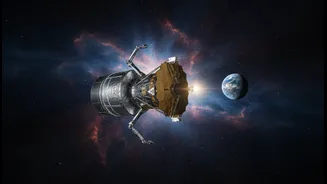
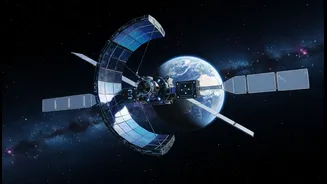
Sometime in the 2040s, NASA plans to launch its next flagship mission, the Habitable Worlds Observatory (HWO). This powerful successor to the James Webb Space Telescope (JWST) has a primary, awe-inspiring goal: to directly image and analyze at least 25
Earth-like planets orbiting nearby stars. By studying their atmospheres for chemical biosignatures like oxygen and methane, HWO will be the first telescope specifically designed to search for signs of life beyond Earth. To achieve this, it will need unprecedented stability—its instruments cannot wobble more than a fraction of a picometer, about 1/50th the diameter of a hydrogen atom—to block a star's glare and capture the faint light of a planet. But the most revolutionary part of HWO isn't just its scientific goal; it's the design philosophy, one that embraces a lesson learned through decades of space exploration.
The Enduring Legacy of Hubble
The Hubble Space Telescope, launched in 1990, was designed for a 15-year mission. More than 30 years later, it continues to produce groundbreaking science. Its longevity is no accident. Hubble was specifically designed to be serviced by astronauts on the Space Shuttle. Over five servicing missions, astronauts repaired failing components, replaced aging gyroscopes and batteries, and, most importantly, swapped out old scientific instruments for newer, vastly more capable ones. Each visit was like giving the telescope a new set of eyes, increasing its scientific power by factors of 10 to 100. This ability to repair and upgrade transformed Hubble from a static piece of hardware into an evolving platform, a lesson that powerfully shaped its legacy.
JWST: A 'One-Shot' Marvel
In contrast, the James Webb Space Telescope was a different beast altogether. To operate, JWST needs to be incredibly cold, which requires it to orbit the sun 1.5 million kilometers from Earth at a stable location called Lagrange Point 2 (L2). This is far beyond the reach of any crewed mission, making astronaut-led servicing impossible. As a result, JWST was designed as a single, fixed-lifecycle observatory. It could not be repaired, refueled, or upgraded. While its performance has been extraordinary, scientists have noted that micrometeoroid impacts have caused more wear than expected, damage that on Hubble could have been addressed by a repair mission. The design was a high-risk, high-reward gamble on a perfect deployment and a limited operational life.
HWO's Future: Robotic Mechanics
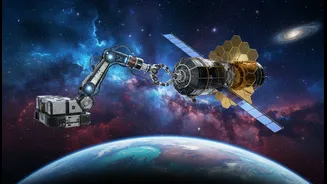
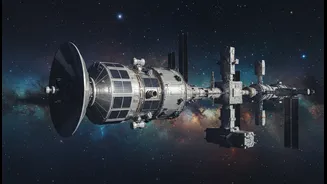
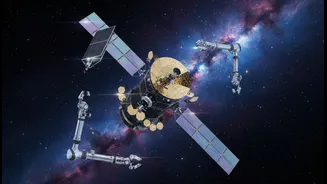
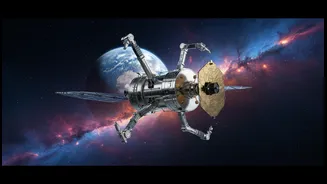
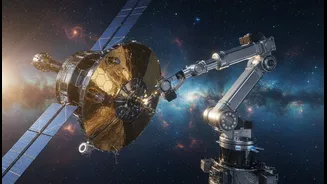
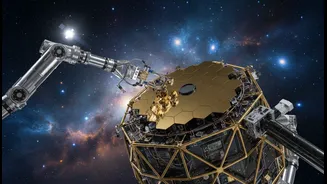
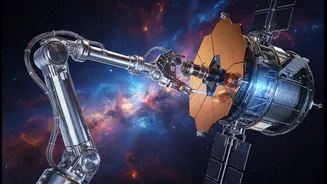
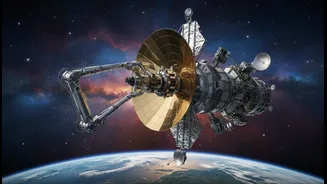
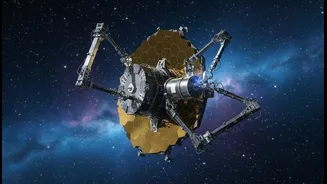
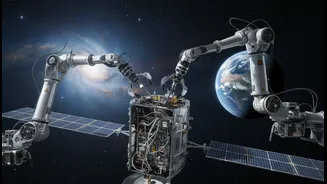
The Habitable Worlds Observatory will also operate at the distant L2 point, but NASA is refusing to accept the same limitations as JWST. The new directive, confirmed at a recent American Astronomical Society meeting, is that HWO must be serviceable. Instead of astronauts, NASA envisions a future where autonomous robotic spacecraft will fly to the observatory to perform maintenance. The telescope is being designed from the ground up with a modular architecture, featuring standardized, line-replaceable units (LRUs) for critical systems. These modules, from computers to scientific sensors, will have docking interfaces and connectors optimized for robotic hands, allowing a service craft to swap out an old instrument for a next-generation one. This could even include in-space assembly if the final telescope is too large to launch in one piece.
An Adaptable, Sustainable Future
This strategic pivot represents a major shift in how NASA approaches its most expensive and ambitious projects. Designing for serviceability adds upfront complexity and cost, but it provides enormous long-term benefits. It extends the observatory's lifespan, maximizing the return on an $11 billion investment. More crucially, it makes the observatory adaptable. Imagine if, 15 years into its mission, HWO finds a compelling candidate for a habitable world. With a serviceable design, NASA could commission a new, more advanced instrument specifically for that target and have a commercial robotic servicer deliver and install it. This ensures that the observatory doesn't remain frozen with 2040s technology for its entire life. It can evolve with our scientific questions and technological capabilities, making it a sustainable asset for generations of astronomers.