

Life’s Essential Legos
To understand the excitement, we first need to talk about peptides. Think of them as short LEGO chains. Each block is an amino acid, and when you link them together, you get a peptide. String many peptides together, and you build proteins—the complex
molecular machines that do almost everything in a living cell. On Earth, peptides and proteins are fundamental to life. Their ability to fold into specific, complex three-dimensional shapes is what allows them to function, whether as enzymes speeding up chemical reactions or as structural components of a cell. Without this chemistry, life as we know it would be impossible.
A Surprising Discovery in a Jar
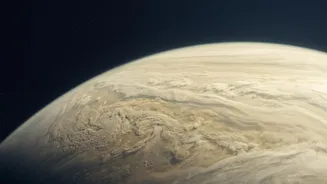
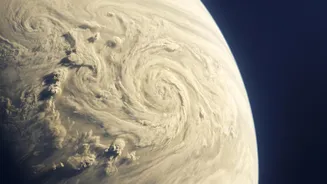
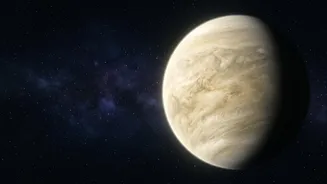
The long-standing assumption has been that Venus's atmosphere, with clouds composed of droplets of up to 98% sulfuric acid, would be a chemical death trap. It’s an environment that would shred most biological molecules. However, a recent study from researchers at MIT and other institutions has challenged this idea directly. In a laboratory setting, they submerged several different peptides in a 98% sulfuric acid solution to mimic the conditions in Venus’s cloud droplets. To their astonishment, the peptides didn’t dissolve. Instead, they remained stable for weeks. The scientists believe this is due to a chemical paradox: the extreme concentration of acid means there is very little water, which is actually required for the acid to break the peptide bonds apart through a process called hydrolysis.
More Than Just Survival
What made the findings even more remarkable was that the peptides did more than just survive; they adopted specific, organized shapes. Using advanced spectroscopy techniques, the researchers observed the peptides folding into structures known as “omega loops”. On Earth, these loops are found in some proteins and are believed to play a role in how they fold and recognise other molecules. The ability to form a stable structure is a critical prerequisite for a molecule to perform a biological function. The team theorises that the sulfuric acid molecules themselves may act as a scaffold, helping to hold the peptide in its folded shape. This result was unexpected and suggests that the fundamental rules of chemistry might operate differently in such an alien, water-poor environment.
What Does This Mean for Life on Venus?
It is crucial to be clear: this study is not proof of life on Venus. The experiments were conducted in a lab on Earth, and scientists have not detected peptides floating in the Venusian clouds. What this research does is show that a major chemical barrier once thought to make Venus uninhabitable might not be so absolute. It opens up the possibility that complex organic chemistry, a precursor to life, could potentially occur there. The findings encourage scientists to broaden their search for life beyond Earth-like worlds with liquid water. If complex molecules can remain stable in other solvents like concentrated sulfuric acid, it forces a rethink of what a habitable planet might look like.
The Lingering Questions and Next Steps
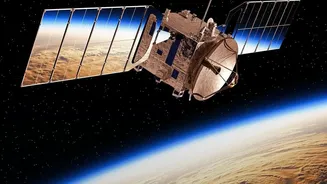
This discovery lands amid a renewed interest in our planetary neighbour. For years, scientists have been puzzled by anomalies in Venus's atmosphere, including unexplained gases and mysterious dark streaks that absorb ultraviolet radiation. While there are many non-biological explanations, these curiosities keep the door open for astrobiology. This new peptide research adds another fascinating piece to the puzzle. The next logical step is to search for these molecules in the Venusian atmosphere itself. Upcoming missions from NASA and the European Space Agency are planned, which could help analyse the chemistry of the clouds in unprecedented detail. In the meantime, researchers plan to test longer, more complex peptides in the lab to see if they too can hold their structure in Venus-like conditions.