




The Classic Picture of Martian Volcanoes
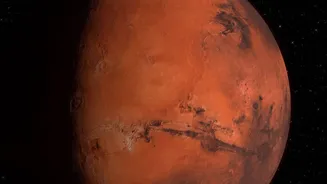
For decades, our view of Martian volcanism was relatively straightforward. Scientists believed that magma from deep within the planet's mantle rose to form huge, isolated chambers of molten rock. These chambers would then feed the colossal shield volcanoes
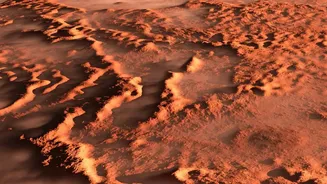
that dominate the Martian landscape, like those in the Tharsis region. This model pictured Mars as a 'stagnant lid' planet — one with a solid, unbroken crust, unlike Earth's shifting tectonic plates. Without plate tectonics to drive complex geology, it was assumed that Mars' volcanic plumbing was simple: vertical pipes leading to massive, but disconnected, volcanoes.
A Groundbreaking Find from InSight
That picture began to change thanks to data from NASA's InSight lander. By studying seismic waves from 'marsquakes' and meteorite impacts, researchers peered deep beneath the red soil. A team from the University of Oxford analyzed this data and focused on a mysterious boundary about 24 kilometers below the surface. Their findings, published in Nature Astronomy, suggested that this boundary wasn't just a change in rock type, but evidence of a vast, buried layer where molten rock once pooled and spread sideways.
Subterranean Rivers of Fire
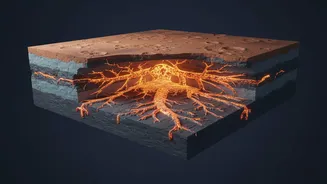
Instead of staying in isolated pockets, the magma on ancient Mars may have formed enormous, interconnected systems that stretched for hundreds or even thousands of kilometers horizontally. Think of it less like a single well and more like a sprawling underground river system made of molten rock. This process, known as 'transcrustal magmatism,' was thought to be unique to Earth, where it's driven by plate tectonics. The discovery that it could happen on a planet without plate tectonics is a major shift in our understanding of planetary geology.
How Did It Work?
Researchers believe that as molten rock rose from the mantle, it pooled at the base of the crust. Over immense timescales, this magma would have gradually separated. Dense, heavy crystals of minerals like iron and magnesium would sink, forming a residue at the bottom. Meanwhile, the lighter, more evolved silica-rich magma would continue to rise or spread sideways. This process created a chemically complex and layered crust, something scientists didn't think was possible on Mars on such a large scale. This underground network could then feed different types of volcanic activity on the surface over long periods.
Rethinking the Red Planet
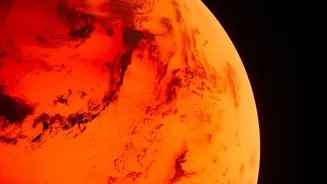
This discovery has profound implications. A more complex volcanic system means Mars was more geologically dynamic than we knew. These vast magma systems would have released enormous amounts of gases and heat, which could have helped create a thicker atmosphere and regulate the planet's climate. They also could have driven hydrothermal systems — where hot, mineral-rich water circulates — creating environments that might have been favorable for life. The find forces scientists to reconsider how rocky planets become habitable, suggesting that the complex geology needed might not be exclusive to worlds with plate tectonics like our own.