





Earth’s Hidden Planetary Engine
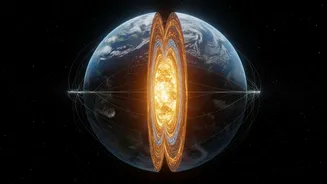
Deep beneath our feet lies a world of extreme heat and pressure. The Earth’s core is composed of two parts: a solid inner core of iron and nickel, and a liquid outer core made of the same molten metals. This outer core, a superheated ocean of liquid iron swirling
about 3,000 kilometers down, acts like a giant dynamo. As the electrically conductive fluid moves and churns, it generates powerful electric currents, which in turn produce our planet’s magnetic field. This magnetic shield is crucial for life, protecting us from harmful solar radiation and charged particles streaming from the sun. Without it, our atmosphere and technological infrastructure would be far more exposed.
Satellites as a Deep-Earth Stethoscope
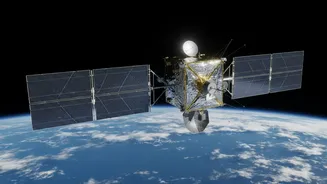
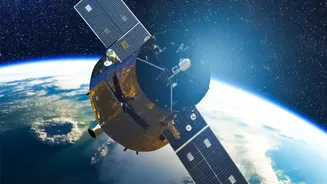
So, how can a satellite in orbit detect what’s happening in the core? It can’t see it directly. Instead, missions like the European Space Agency's (ESA) Swarm constellation act like a planetary stethoscope. Launched in 2013, the three identical Swarm satellites fly in precise orbits, equipped with highly sensitive magnetometers that measure the strength and direction of the magnetic field with exceptional accuracy. By comparing measurements from different locations and altitudes, scientists can filter out magnetic signals from the crust, oceans, and atmosphere to isolate the subtle changes originating from the core. These tiny fluctuations in the magnetic field provide clues about the motion of the liquid iron deep below.
The Surprising Core-Flow Reversal
For decades, measurements suggested that the flow in the outer core was dominated by a relatively stable westward drift. But by analysing nearly 30 years of data from missions including Swarm, CHAMP, and Ørsted, scientists uncovered a dramatic and unexpected event. Around 2010, a huge river of molten iron deep beneath the Pacific Ocean abruptly reversed course. What was once a weak westward flow began surging strongly to the east. This wasn't a reversal of the entire core, but a significant regional change that challenged previous assumptions about the core's behaviour being relatively stable. The exact reason for this sudden shift remains a mystery to scientists.
What Does This Reversal Mean?
While an event this dramatic sounds alarming, scientists have stated it poses no immediate danger to people on the surface. However, it provides a fascinating window into the turbulent processes that govern our planet's interior. Researchers are now trying to understand if this reversal was a short-lived fluctuation, part of a longer, repeating cycle, or the beginning of a new stable state for core circulation. Recent data from ESA even suggests the eastward flow has begun to weaken since 2020, adding to the theory that it might be part of a natural oscillation. These changes in core flow are linked to observable phenomena like 'geomagnetic jerks'—sudden, rapid shifts in the magnetic field—and may even cause minuscule changes to the length of a day, though by less than a thousandth of a second.
Why This Deep-Earth Research Matters
Understanding the core’s behaviour isn't just an academic exercise. The magnetic field is constantly evolving, and these shifts affect practical technologies we rely on every day, including navigation systems like GPS and spacecraft operations. Better models of the core can help us predict how the magnetic field will change in the future. Furthermore, this research deepens our understanding of the fundamental geodynamics that make Earth a habitable planet, including the processes that drive plate tectonics and protect our atmosphere. The satellite-detected reversal reveals that the deep Earth is far more dynamic and capable of rapid change than previously thought, offering new clues into how our world truly works from the inside out.