





A Surprising Stone Grid
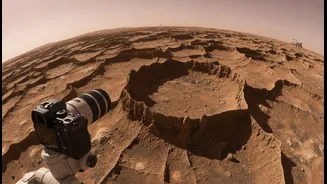
While exploring the foothills of Mount Sharp within Gale Crater, the Curiosity rover was sent to investigate an area that appeared bright and uniform in orbital images. But when the rover arrived, the science team was met with a surprise: the ground was not
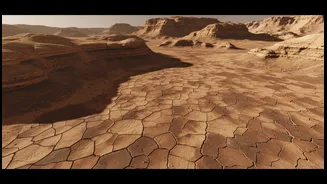
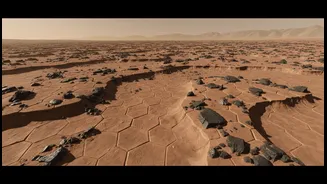
smooth at all. Instead, it was covered in a network of raised, rocky ridges forming a series of interconnected polygons, resembling a giant, natural honeycomb. This striking pattern was a visual shock, transforming a seemingly unremarkable patch of ground into a key area of scientific interest. The ridges themselves stand out against the darker sand that has filled the depressions between them, creating a starkly beautiful and mysterious landscape.
Decoding the Honeycomb
So, what could create such a regular, geometric pattern on a planetary surface? Scientists have a compelling explanation rooted in a familiar earthly process: the drying of mud. The theory is that this area was once wet mud that cracked as it dried out. However, unlike a single drying event which typically forms T-shaped cracks, these patterns suggest something more significant. Repeated, cyclical periods of wetting and drying—perhaps seasonally—caused the initial cracks to soften and merge into more complex Y-shaped junctions, eventually forming the stable hexagonal pattern seen today. Over billions of years, these cracks were filled with minerals that were more resistant to erosion than the surrounding mudstone. As wind slowly wore away the softer material, the harder, mineral-filled cracks were left standing in relief as ridges.
A Window into an Ancient Climate
This discovery is more than just a geological curiosity; it is tangible evidence of Mars's ancient climate. The honeycomb pattern provides the first clear proof that the Red Planet once experienced regular, Earth-like wet-dry cycles. Instead of a simple history where Mars was wet and then became permanently dry, this finding points to a much more dynamic past. It suggests a sustained, cyclical climate that could maintain liquid water on the surface for extended periods, even if it was seasonal. This completely changes our picture of ancient Mars, painting it as a world with recurring weather patterns rather than just sporadic events like volcanic activity or meteor impacts causing temporary water flows.
The Significance of Gediz Vallis
The location of this find is also critical. Curiosity discovered these features while exploring near a feature called the Gediz Vallis channel, a winding landform believed to have been carved by flowing water and debris flows billions of years ago. Finding evidence of sustained wet-dry cycles in a region already associated with ancient rivers reinforces the idea that this part of Gale Crater was a hub of aqueous activity. The rover is studying layers of sediment on Mount Sharp to piece together the timeline of how Mars transitioned from a potentially habitable, watery world to the cold desert it is today. The honeycomb ridges are a crucial clue from one of the last wet periods on this part of the planet.
Paving the Way for Life?
While these ridges are not evidence of life itself, they point to conditions that may have been favorable for its emergence. On Earth, repeated wet-dry cycles are considered by some scientists to be a crucial ingredient for the chemical evolution that can lead to life. These cycles can concentrate the organic molecules necessary for life to begin. For over a decade, Curiosity has found ample evidence that ancient Mars could have supported microbial life if it ever existed. Now, with the discovery of these honeycomb mud cracks, the mission has found evidence of conditions that may have promoted the very origin of life. It makes areas like this prime targets in the ongoing search for biosignatures, the preserved chemical fingerprints that ancient organisms might have left behind.