






The Icy Heart of a Distant World
Ever since NASA's New Horizons spacecraft flew by Pluto in 2015, scientists have been captivated by Sputnik Planitia, a massive basin filled with frozen nitrogen that forms the western lobe of its iconic 'heart'. This enormous glacier, larger than Texas
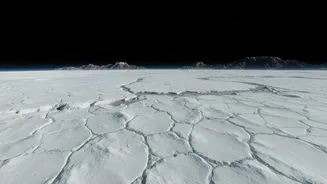
and Oklahoma combined, is remarkably smooth and lacks impact craters, indicating its surface is surprisingly young on a geological timescale—likely less than a million years old. The surface is covered in city-sized polygonal blocks of ice, which scientists believe are slowly churning in a process called convection, similar to the blobs in a lava lamp. This constant renewal scrapes the surface clean of craters, hinting at a world that is far from dormant.
A New Theory Bubbles Up
A recent study published in the Planetary Science Journal provides compelling new evidence for an even more dynamic process. By re-analyzing high-resolution images from New Horizons, a team led by Alan Stern, the mission's principal investigator, identified dark streaks and diffuse patches along the boundaries of Sputnik Planitia's northern ice cells. These features look strikingly similar to patterns seen on Earth's own ice sheets, like in Greenland, where liquid water has welled up from beneath and 'wetted' the surface. Since Pluto's thin atmosphere and frigid temperatures make liquid nitrogen rain impossible, the researchers propose that this liquid is coming from below.
The Science of a Celestial Spring
The hypothesis suggests that heat radiating from Pluto's rocky core could be just enough to melt the nitrogen ice at the very base of the kilometers-deep glacier. While Pluto's internal heat is modest, the immense pressure at that depth, combined with the low melting point of nitrogen, could create pockets of liquid nitrogen. This liquid nitrogen, being less dense than the solid ice above it, would then become buoyant. Computer models show it could travel upwards through small fractures or conduits in the ice sheet, much like magma rising through dikes in Earth's crust. Upon reaching the frigid surface, this liquid would flow for a short time before refreezing, darkening the ice and creating the distinct patterns observed by New Horizons.
Why This Finding Is a Big Deal
This is the first strong evidence for recently flowing liquid on Pluto's surface. It transforms our understanding of the dwarf planet from a mostly static, frozen ball to a geologically active world with ongoing subsurface processes. This discovery not only adds a new layer of complexity to Pluto but also has implications for other icy bodies in the outer solar system. Understanding how liquid can form and move on Pluto could provide clues about similar phenomena, such as the mysterious geysers observed on Neptune's moon Triton. As New Horizons principal investigator Alan Stern noted, "Pluto never stops surprising us." The finding suggests that even in the coldest, most distant reaches of our solar system, complex and active geology can persist, powered by subtle forces over immense timescales.