

Meet Our Galactic Neighbor
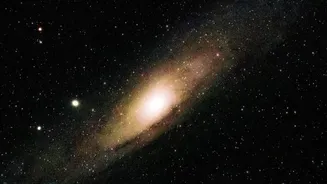
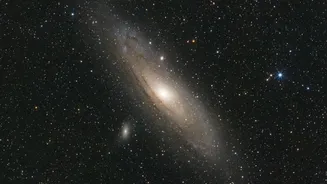
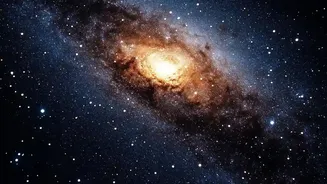
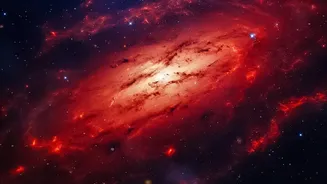
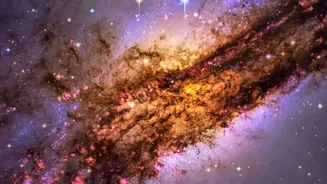
The Andromeda galaxy, also known as M31, is the closest major galaxy to our own Milky Way. Visible to the naked eye as a faint smudge in the night sky, it's a spiral galaxy similar in size to our own. This proximity makes it a unique natural laboratory
for astronomers. While we are stuck inside the Milky Way, unable to get a clear, outside view of our own galactic structure, Andromeda offers a perfect panoramic perspective. Studying its evolution helps scientists understand the life cycles of galaxies across the universe, including providing hints about the past and future of our own home.
Hubble's Galactic Fossil Hunt
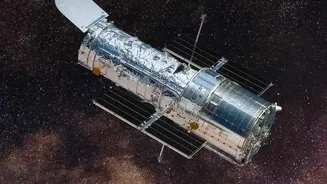
To piece together Andromeda's story, astronomers turned to the Hubble Space Telescope. A recent study analyzed a treasure trove of data from two extensive surveys, the Panchromatic Hubble Andromeda Treasury (PHAT) and the Panchromatic Hubble Andromeda Southern Treasury (PHAST). Together, these projects mapped about two-thirds of the galaxy's sprawling disk, cataloging an astonishing 200 million individual stars. By analyzing the color of these stars, scientists can create a 'fossil record' of star birth. Massive, young stars burn hot and appear blue, but they have short lives. Older, less massive stars are cooler and redder. By mapping the distribution of blue and red stars, astronomers can effectively rewind time and see where and when stars have been forming over cosmic history.
A Galaxy Winding Down
The study's most significant finding is that Andromeda's star-making days are slowing down considerably. While the galaxy experienced a massive burst of star formation about two billion years ago, likely from a collision with another galaxy, it has since been on a long, steady decline. The new data shows this slowdown has been happening for the last 500 million years. Around that time, Andromeda was creating stars at a rate of about one solar mass per year—similar to the Milky Way today. However, that rate has dropped dramatically, with a particularly steep decline in just the last 40 million years. Today, Andromeda's star formation rate has plummeted to about one-fifth of a solar mass per year.
The Prime Suspect: A Galactic Bully?
So what caused this recent, sharp drop in activity? Astronomers believe they have identified a prime suspect: M32, a small satellite galaxy orbiting Andromeda. Researchers noted that the slowdown in star formation was not uniform across the galaxy's disk. Instead, the area of Andromeda closest to M32 showed a pronounced decrease in star birth that started around 60 million years ago. While it's difficult to prove definitively, the timing and location strongly suggest that an interaction with M32 may have disrupted gas clouds in Andromeda's disk, effectively stifling star formation in that region. Scientists call M32 the 'most likely suspect' for bullying its larger neighbor into a quieter state.
A Glimpse of Our Cosmic Future
Understanding Andromeda's history isn't just an academic exercise; it's also a preview of our own distant future. The Milky Way and Andromeda are bound together by gravity and are hurtling toward each other at a speed of over 100 kilometers per second. In about 4.5 billion years, the two galaxies are predicted to collide and merge, eventually forming a single, massive new galaxy dubbed 'Milkomeda'. By studying how Andromeda has been shaped by past collisions and interactions, like the one suspected with M32, astronomers can build better models of this future galactic merger. These studies help us comprehend the powerful, dynamic forces that shape the cosmos, revealing that galaxies are not static islands but are constantly evolving entities.