





A Cosmic Case of Mistaken Identity
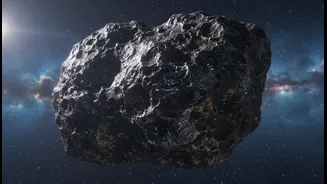
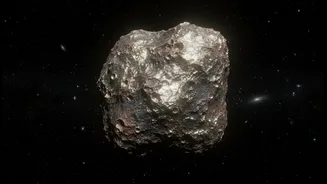
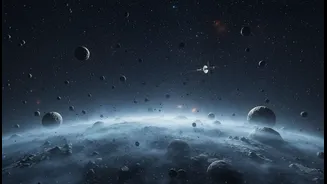
For decades, the object known as 1998 SH2 was filed away in astronomical catalogues as a near-Earth asteroid. Discovered in 1998, its journey through the solar system seemed unremarkable. Like all celestial bodies, its path was dictated by the immense
gravitational pull of the Sun and other planets, allowing scientists to create precise forecasts of its location. But during a close approach to Earth in August 2025, something was amiss. When astronomers pointed their instruments to its predicted location, 1998 SH2 was a no-show. It hadn't vanished, but had deviated significantly from its expected trajectory, sparking a fascinating scientific investigation. The object was there, just not where gravity alone said it should be.
The Unseen Push
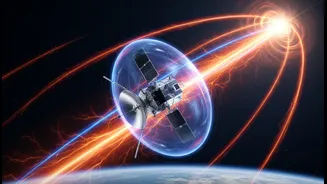
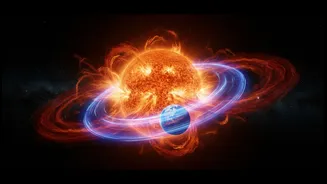
The universe is largely governed by gravity, the force that keeps planets in orbit and galaxies clustered together. For massive objects, its effects are overwhelming and predictable. For smaller bodies like comets and asteroids, however, other subtle forces can come into play. These are known as non-gravitational forces, and they act like invisible nudges that can alter an object's path over time. The mystery of 1998 SH2's drift led researchers at NASA's Jet Propulsion Laboratory to suspect such a force was at work. They hypothesised that the object wasn't a simple, inert asteroid but something more active—something that was gently pushing itself through space.
A Comet's Inner Engine
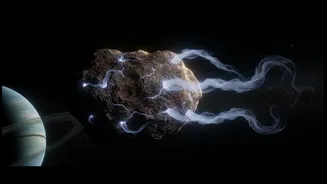
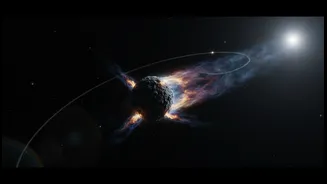
The leading explanation was a process called gas venting, or outgassing. Comets are often described as 'dirty snowballs'—conglomerations of ice, rock, and dust. As a comet nears the Sun on its orbital journey, the solar radiation heats its surface. This warmth causes the frozen gases trapped within, such as water and carbon dioxide, to turn directly from solid ice into gas in a process called sublimation. This gas then bursts from the nucleus, often in powerful jets. According to Newton's third law, for every action, there is an equal and opposite reaction. The escaping gas acts like a tiny, natural rocket engine, providing a gentle but persistent thrust that pushes the comet off the path dictated purely by gravity.
From Hypothesis to Confirmation
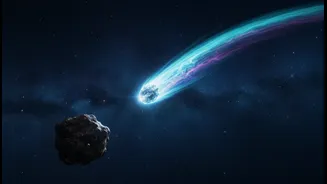
To prove that 1998 SH2 was secretly a comet, scientists needed visual evidence. The problem was that past observations showed no obvious cometary features like a bright, fuzzy coma or a distinct tail. This suggested any outgassing was incredibly weak. The team turned to some of the most powerful observatories on Earth, including the European Southern Observatory's Very Large Telescope in Chile. Peering deep into space, these instruments captured what smaller telescopes could not: a faint but clear tail of gas and dust trailing behind the object. The smoking gun was found. The orbital deviation wasn't an error; it was the signature of a comet, albeit a very subtle one. The object has since been given a new designation, P/1998 SH2, to reflect its true identity.
Why 'Dark Comets' Matter
The reclassification of 1998 SH2 is more than just a cosmic correction. It sheds light on a mysterious class of objects known as 'dark comets'. These bodies exhibit cometary behaviour, like orbital perturbations from outgassing, but lack the spectacular visual tails that make other comets famous. They are comets hiding in plain sight, masquerading as asteroids. This discovery has significant implications for planetary defense. Accurately predicting the future path of any near-Earth object is critical to assessing its potential impact risk. If an object is being influenced by its own gas jets, a model based on gravity alone will be wrong. As one scientist noted, continuously tracking these objects and detecting these subtle perturbations is an important diagnostic tool that helps us understand which objects may pose a threat in the future.