





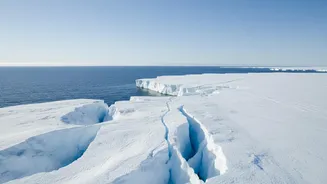


A New View of Invisible Energy
When we think of heat, we don't typically picture the icy landscapes of the Arctic and Antarctic. Yet, these regions play a crucial role as Earth's refrigerators, radiating enormous amounts of energy out into space. A significant portion of this energy,
however, has been notoriously difficult to measure. This 'hidden heat' exists in the form of far-infrared radiation, a range of the light spectrum that is invisible to our eyes. In fact, nearly 60 percent of the energy Earth loses to space is in this form. For decades, our global observing systems haven't been able to comprehensively track it, leaving a major gap in our understanding of the planet's energy budget. This omission is critical, as the poles are warming at a much faster rate than the rest of the planet, a phenomenon known as Arctic amplification.
Meet the PREFIRE Mission
To fill this knowledge gap, NASA launched the Polar Radiant Energy in the Far-InfraRed Experiment, or PREFIRE, mission. Starting in July 2024, two small, shoebox-sized satellites known as CubeSats began orbiting over the poles. These are not just any satellites; each is equipped with a special thermal infrared spectrometer designed specifically to measure these elusive far-infrared emissions. The mission's goal is to get the first-ever comprehensive look at when, where, and how this heat radiates from the Arctic and Antarctic throughout the year. By capturing two full seasonal cycles at both poles, scientists now have an unprecedented continuous record of this vital component of our climate system.
What the Two-Year Record Reveals
The data, presented in new animations from NASA, visualizes the dramatic pulse of the seasons at both poles. It shows the stark contrast between the Arctic, where summers can thaw tundra and sea ice, and Antarctica, which largely remains below freezing even during its mildest periods. More importantly, the data provides direct measurements of how different surfaces—like snow, sea ice, and open ocean—emit far-infrared heat differently. Earlier research has suggested that open ocean water is much less efficient at emitting this energy than ice is, meaning that as sea ice melts, more of this heat gets trapped in the ocean, further accelerating warming. The PREFIRE data is giving scientists the direct observations needed to confirm and refine these theories, which were previously based on models.
Why This 'Hidden Heat' Matters Globally
The 'hidden' aspect of this heat isn't that it's a new phenomenon, but that it's newly and precisely measured. This data is essential for refining climate and weather models. Understanding how much heat is escaping from the poles helps scientists better predict everything from sea-level rise to shifting weather patterns that can affect the entire globe. The poles act as the planet's air conditioner; what happens there doesn't stay there. Disruption in the polar regions can influence the jet stream, leading to more extreme weather events in the Northern Hemisphere. Furthermore, accurately tracking the melt of the Greenland and Antarctic ice sheets, which is influenced by this energy balance, is crucial for coastal communities worldwide facing the threat of rising sea levels.
A Clearer Picture for a Changing World
The completion of PREFIRE's first two years of observation marks a milestone in climate science. By filling a critical observational gap, the mission provides a clearer picture of Earth's energy budget. This isn't just an academic exercise; the data has practical implications for everything from shipping routes opening up in the warming Arctic to managing resources in communities affected by climate change. As scientists begin to integrate this trove of new information into global climate models, our ability to forecast the future of our planet becomes more robust. For the first time, we are truly seeing the full spectrum of energy that Earth radiates into space, which is a critical step in understanding and responding to climate change.