

A Glimpse into the Cosmic Dawn
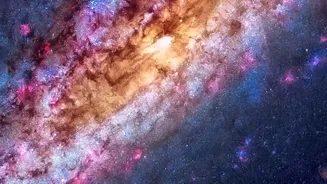
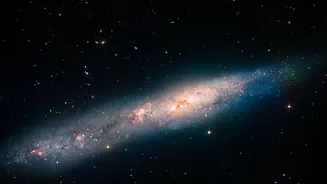
Imagine looking so far across space that you are also looking back in time. That’s what astronomers did when they pointed the James Webb Space Telescope (JWST) at J0148-4214. The light from this galaxy has travelled for over 12.5 billion years to reach
us, meaning we see it as it was just 1.2 billion years after the Big Bang. This period, known as the cosmic dawn, is when the first stars and galaxies were forming. Initially, scientists thought J0148-4214 hosted a single, active supermassive black hole. But when a team led by the Max Planck Institute for Extraterrestrial Physics took a closer look using advanced instruments, they found something far more complex and exciting.
Not One, But Three Black Holes
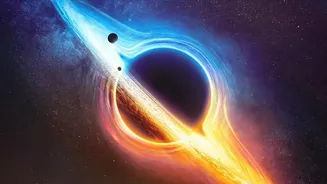
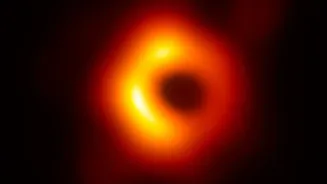
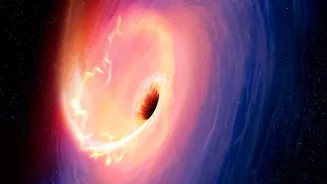
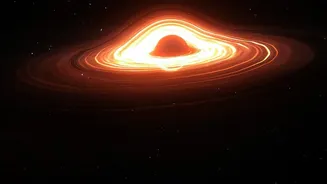
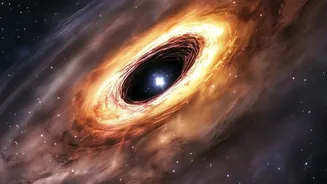
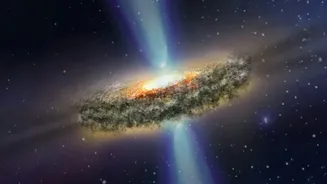
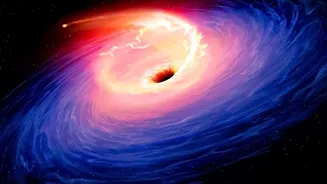
Instead of a single object, the JWST data revealed the tell-tale signs of three actively feeding supermassive black holes within the same galaxy. Astronomers can't see the black holes directly, but they can detect the intensely bright, swirling gas of their accretion disks—matter being pulled in at incredible speeds. Two of these black holes are huddled together in the galaxy's center, separated by a mere 190 parsecs, or about 620 light-years. In cosmic terms, this is incredibly close. A third black hole, with a mass of about two million Suns, orbits further out, around 5,500 light-years from the central pair.
A Cosmic Dance of Giants
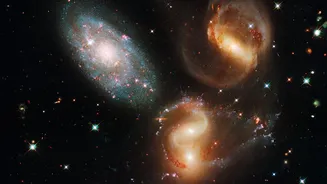
The central pair consists of a behemoth, about 80 million times the mass of our sun, and a smaller companion of about 600,000 solar masses. Intriguingly, the smaller black hole is growing at a furious pace, accreting matter faster than standard theories predict is possible. This trio is the first of its kind ever observed in the distant universe. Its existence provides powerful, direct evidence for a leading theory of black hole growth: galactic mergers. In the chaotic early universe, galaxies frequently collided and merged. When they did, their central black holes would have been drawn together, eventually combining to form an even larger one.
Solving the Growth Spurt Mystery
The discovery helps explain how black holes in the early universe reached masses of billions of suns far quicker than models of steady growth would allow. Seeing this process in action in J0148-4214 suggests that these cosmic pile-ups were a common and efficient way to build up mass rapidly. The central pair in J0148-4214 is expected to merge in a few hundred million years, a relatively short timescale in astronomy. The third, more distant black hole might be a remnant from a previous merger or a newcomer slowly making its way to the center. This discovery demonstrates that some of the universe's first giants didn't grow in isolation, but by consuming their peers.
The Future of Cosmic Discovery
This finding was made possible by the incredible power of the James Webb Space Telescope's NIRSpec instrument, which can create a detailed spectral map of a galaxy instead of just a single, blended image. Without this technology, the multiple black holes would have appeared as one. The discovery of this black hole triplet opens a new window into the universe's formative years. It also serves as a preview of what future gravitational-wave observatories, like the planned Laser Interferometer Space Antenna (LISA), might detect. The mergers of systems like this one will one day send ripples through spacetime, and J0148-4214 gives us a snapshot of the ancestors of those epic events.