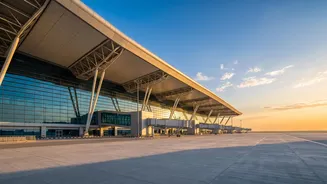










1. Indira Gandhi International Airport (DEL), Delhi
Holding onto the top spot, Delhi's Indira Gandhi International Airport (IGIA) is India's undisputed aviation leader. According to data for the financial year 2025-26 from the Airports Authority of India (AAI), IGIA handled a staggering 7.87 crore passengers.
Its position is bolstered by its role as the primary gateway to North India and a massive hub for both international and domestic flights. In fact, IGIA was the only Indian airport to rank among the world's top 15 busiest in 2025. The airport is a critical transit point, with nearly one in four passengers connecting through Delhi to other destinations. This vast network and high frequency of flights ensure it remains far ahead of the competition.
2. Chhatrapati Shivaji Maharaj International Airport (BOM), Mumbai
As the financial capital of India, Mumbai's airport consistently holds the number two position. In FY 2025-26, it handled over 5.52 crore passengers. Despite its significant traffic, Mumbai's growth has been modest compared to other major airports, partly due to infrastructure constraints in the dense city. It serves as a crucial hub for business travel and international connectivity, particularly to the Middle East, Europe, and Africa. The much-anticipated Navi Mumbai International Airport is expected to alleviate some of the pressure on BOM and cater to the growing demand in the Mumbai Metropolitan Region.
3. Kempegowda International Airport (BLR), Bengaluru
Bengaluru's Kempegowda International Airport is the fastest-growing major airport in India, rapidly closing the gap with Mumbai. It handled approximately 4.44 crore passengers in FY 2025-26, a significant jump driven by the city's booming IT and startup ecosystem. The airport is known for its modern infrastructure, including a new terminal that has expanded its capacity, and its focus on technology and sustainability. Its strong growth reflects Bengaluru's rising prominence as a global business and technology hub, attracting both corporate and leisure travellers.
4. Rajiv Gandhi International Airport (HYD), Hyderabad
Hyderabad's airport has firmly established itself as a key player in Indian aviation, securing the fourth spot with around 3.04 crore passengers in FY 2025-26. Physically, it is the largest airport in India by area, allowing for significant expansion. The airport has transformed into a major transit hub for South and Central India. Its growth is also fueled by Hyderabad's emergence as a pharmaceutical and biotech capital, along with a thriving MICE (Meetings, Incentives, Conferences, and Exhibitions) industry. The airport's efficient operations and connectivity continue to attract more airlines and passengers.
5. Chennai International Airport (MAA), Chennai
Rounding out the top five, Chennai's airport remains a vital gateway to South India and a key hub for traffic to and from Southeast Asia. Serving as a major centre for the automobile, manufacturing, and healthcare industries, Chennai's airport supports significant business and cargo traffic. While it faces increasing competition from Bengaluru and Hyderabad, its strategic location and strong domestic and regional connectivity ensure it remains one of the country's busiest airports. Ongoing modernization and expansion projects are aimed at enhancing passenger experience and increasing its capacity for future growth.