






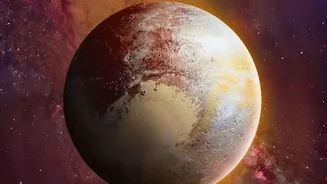
The Red Planet's Rusty Clue
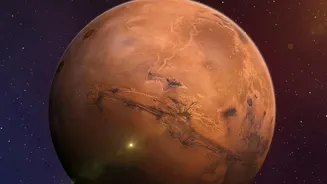
At its heart, the story of Mars's iconic red color is a story about rust. Hematite, a specific type of iron oxide (α-Fe2O3), is incredibly common across the Martian surface, giving the planet its distinctive reddish tint. For decades, scientists have
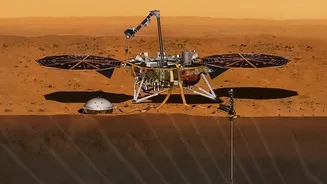
known that on Earth, most hematite forms in the presence of water. This made its discovery on Mars a landmark moment, providing compelling evidence that the planet wasn't always the cold, dry desert it is today. Missions like NASA's Mars Global Surveyor and Mars Odyssey used spectrometers to map significant deposits of this mineral, particularly a coarse-grained, crystalline form that strongly points to an aqueous origin. These initial discoveries, made from orbit, essentially painted a giant X on the Martian map, telling scientists exactly where to land rovers to follow the water trail.
Not All Hematite Is the Same
The simple presence of hematite points to water, but the details of its structure—its crystal size and form—tell a much more complex story involving heat. A recent study of samples from Gale Crater, collected by the Curiosity rover, has turned hematite into a kind of geological thermometer. Scientists found that hematite crystals at deeper, older rock layers were significantly larger than those found in younger layers at higher elevations. This difference is a direct result of the conditions under which they formed. The larger crystals found in the older rock layers could only have grown over long periods in warmer water. This process, known as Ostwald ripening, involves smaller crystals dissolving and re-forming onto larger ones, a process that requires sustained warmth and liquid water. The smaller crystals in younger rocks, by contrast, suggest a colder, drier environment where water was scarce or fleeting.
A Tale of Two Minerals
The plot thickens with the presence, or absence, of another iron-bearing mineral: goethite. In the younger, higher-elevation rocks of Gale Crater, scientists found both hematite and goethite. However, in the older, deeper layers where the large hematite crystals reside, goethite was missing. On Earth, goethite transforms into hematite under warm, neutral-to-alkaline water conditions. The conclusion is clear: the older layers of Mars experienced a long period where warm groundwater circulated, converting goethite into large-crystal hematite. This suggests the existence of long-lived, warm aquifers that may have persisted for millions of years, even as the Martian surface climate was growing colder and drier.
From Blueberries to Buried Reservoirs
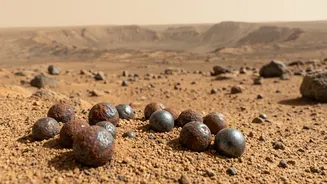
This isn't the only form of hematite telling tales. One of the most famous discoveries by the Opportunity rover was of small, spherical hematite concretions nicknamed "blueberries". These formations, found in Meridiani Planum, are thought to have precipitated from groundwater flowing through porous rock billions of years ago. While the headline-grabbing discoveries often focus on specific regions like Meridiani Planum or Gale Crater, some research suggests hematite's presence in ordinary Martian soil is more widespread than previously thought. A re-analysis of data from the Spirit rover found faint but persistent signals of crystalline hematite across Gusev Crater, implying water's influence was incredibly far-reaching. Other research even suggests that some forms of hematite, called hydrohematite, can store water within their crystal structure, hinting at a hidden water reservoir on a planet that appears bone-dry.
Why This Rusty Mineral Matters
Understanding how and where hematite formed is crucial for one of the biggest questions in science: did life ever exist on Mars? The evidence for long-lasting, warm, liquid water—as told by the size and distribution of hematite crystals—points to environments that were potentially habitable. While some hematite can form through high-temperature volcanic processes without water, the types found in key locations like Meridiani Planum and Gale Crater are inextricably linked to aqueous processes. By piecing together this mineralogical puzzle, scientists can reconstruct Mars's ancient climate and identify the most promising locations to search for biosignatures. Each rusty rock is a breadcrumb leading scientists back in time to a Mars that was warmer, wetter, and far more dynamic than the world we see today.