




The Giant-Impact Hypothesis
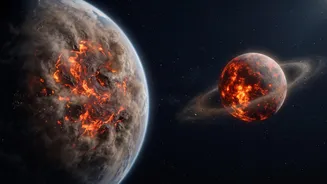
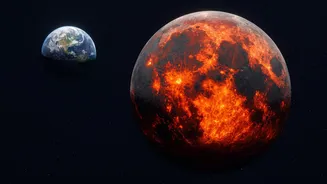
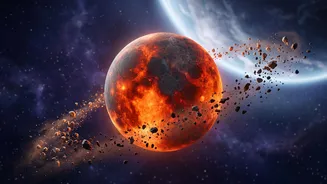
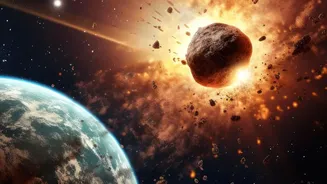
For decades, the most widely accepted explanation for the Moon's existence has been the Giant-Impact Hypothesis. The story goes that about 4.5 billion years ago, when our solar system was a chaotic construction zone, a Mars-sized planet named Theia collided
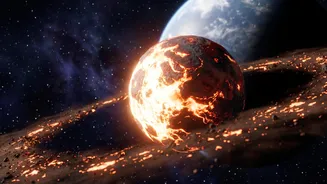
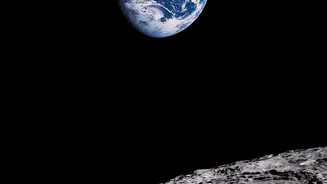
with the proto-Earth. This wasn't a head-on crash, but a colossal glancing blow that sent a massive spray of vaporized rock and debris into orbit. Over months or years, gravity pulled this material together, forming the Moon we know today. This theory elegantly explains several key features of the Earth-Moon system, such as the Moon's large size relative to Earth and the high angular momentum of their shared orbit. For a long time, it was the neatest answer to one of our solar system's biggest questions.
A Cosmic Fingerprint Problem
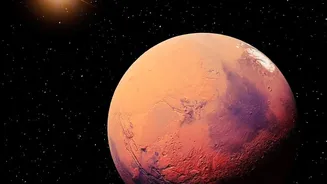
The trouble began when scientists analyzed the lunar rocks brought back by the Apollo missions. They discovered something startling: the Earth and Moon are chemically almost identical. Specifically, they share nearly the same ratios of stable isotopes for elements like oxygen and titanium. In the solar system, isotopic compositions act like a planetary fingerprint; bodies that form in different regions have distinct signatures. The rocks on Mars, for example, have a different isotopic fingerprint than Earth's. The Giant-Impact Hypothesis predicted that the Moon should be made mostly from the material of the impactor, Theia. Since Theia likely formed elsewhere in the solar system, it should have had a different fingerprint. The fact that the Moon's fingerprint matches Earth's so closely created what scientists call an "isotopic crisis."
Why the Similarity Is a Puzzle
If the Moon is mostly made of Theia, why does it look like it's made of Earth? This is the core of the problem. Early simulations suggested that a glancing blow would result in a Moon composed of 60-80% material from Theia. For the Earth and Moon to be isotopic twins, it would mean that Theia and the proto-Earth must have also been twins, forming from the exact same primordial material. While some models suggest this is possible, it's considered a statistically unlikely coincidence. This has forced scientists to rethink the specifics of the impact. Perhaps the collision was far more violent than first imagined, energetic enough to thoroughly mix the material from both planets before the Moon formed. Or maybe the story needs a more radical rewrite.
Refining a Violent Birth
To solve this chemical conundrum, scientists have proposed several modifications to the Giant-Impact story. One idea involves a much higher-energy impact that vaporized not just the impactor but a large portion of Earth's mantle, creating a massive, well-mixed cloud of material. A more recent and intriguing model introduces a new type of celestial object: a 'synestia'. In this scenario, the collision was so energetic it didn't just create a debris disk, but a single, rapidly spinning, doughnut-shaped mass of vaporized rock. The Moon then condensed from this vapor within the synestia, which later cooled to form the modern Earth. Because both bodies would have formed from the same homogenized cloud of vapor, this would naturally explain their chemical similarity. Other recent simulations even suggest the Moon could have formed directly in orbit in a matter of hours, not years, following the impact.