






The Throwaway Era of Rockets
For the first six decades of the space age, every rocket launch followed a simple but incredibly wasteful formula. A rocket, a marvel of precision engineering costing tens or hundreds of millions of dollars, would fire for a few minutes to push its payload
towards orbit and then be discarded. Its most expensive components, the powerful first-stage engines and structures, would burn up on reentry or sink to the bottom of the ocean. Imagine a commercial airline having to build a brand-new aircraft for every single flight. That was the prohibitive economic model of space access for generations, making it an exclusive domain for superpower governments and a handful of large corporations.
A Paradigm Shift in Engineering
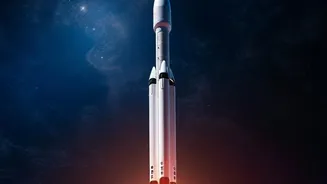
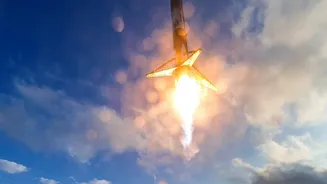
SpaceX fundamentally challenged this model with its Falcon 9 rocket. Instead of treating the first-stage booster as disposable, it was engineered for return and reuse. After stage separation, the booster performs a series of complex, automated maneuvers. It flips around, executes engine burns to slow its descent, deploys grid fins for atmospheric steering, and finally relights its central engine for a gentle, propulsive landing on either a concrete pad or an autonomous droneship waiting in the ocean. The first successful recovery in December 2015 was a watershed moment, proving that what was once a theoretical dream was a practical reality. Since then, SpaceX has landed boosters hundreds of times, with some individual boosters flying more than 30 missions.
The Reusability Dividend
The economic impact of this innovation cannot be overstated. By reusing the most expensive part of the rocket, SpaceX dramatically slashed the cost of launching satellites. A Falcon 9 launch is advertised at a fraction of the cost of its competitors who use traditional, expendable rockets. This cost reduction has done two things: first, it allowed SpaceX to capture a dominant share of the global commercial launch market. Second, and more importantly, it has made space accessible to a new generation of companies and projects. The rapid deployment of massive satellite constellations like SpaceX's own Starlink would be economically impossible without reusability. The high launch frequency—sometimes with just days between a booster's flights—is a direct result of having a fleet of flight-proven hardware ready to go.
An Industry Forced to Adapt
SpaceX’s success did not go unnoticed. Competitors who once dismissed reusability as an impractical fantasy are now racing to develop their own reusable systems to stay competitive. United Launch Alliance (ULA), a longtime industry stalwart, is developing its Vulcan rocket with a plan to eventually recover the first-stage engines. Jeff Bezos's Blue Origin is designing its New Glenn rocket with a fully reusable first stage that will also land on a ship at sea. Across the globe, from Europe's ArianeGroup to emerging players in China, the message is clear: the future of launch is reusable, and any company operating with a purely expendable model is at a severe competitive disadvantage.
Beyond Boosters: The Next Frontier
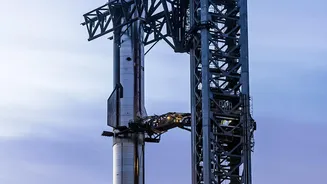
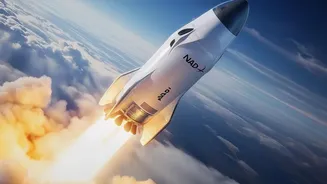
Even as the Falcon 9 continues its record-setting cadence, SpaceX is already building the next generation of reusable spacecraft: Starship. This colossal vehicle is designed to be fully and rapidly reusable, meaning both the Super Heavy booster and the Starship upper stage will return for landing. Instead of landing on legs, the Super Heavy booster is designed to be 'caught' by giant mechanical arms on the launch tower, a system intended to make relaunch even faster. While still in its test phase, Starship represents the ultimate expression of the reusability doctrine. If successful, it promises to reduce launch costs by another order of magnitude, potentially enabling ambitious goals like large-scale lunar bases and human settlement on Mars.