





A Planet's Invisible Shield
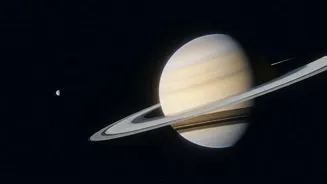
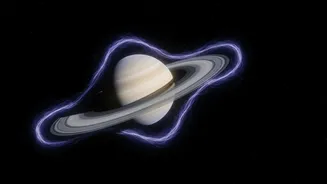
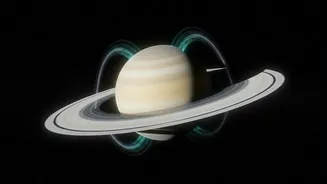
Every planet with a magnetic field, including Earth, is cocooned in a protective bubble called a magnetosphere. This shield deflects the solar wind, a constant stream of charged particles from the Sun. Without it, a planet's atmosphere could be stripped
away. But Saturn’s magnetosphere is bizarre. Unlike Earth's, which is neatly tilted relative to its spin axis, Saturn's magnetic field is almost perfectly aligned with its rotation. This alignment has made one of the most fundamental questions about the planet—how long is a day on Saturn?—impossibly difficult to answer.
The Mystery of the Ticking Clock
For gas giants without a solid surface, scientists measure the rotation period by tracking radio emissions controlled by the magnetic field. But Saturn gives conflicting results. Measurements by the Voyager probes in the 1980s gave a rotation period of about 10 hours and 39 minutes. When Cassini arrived in 2004, it measured the period as six minutes longer. Scientists knew the entire planet hadn't slowed down. Instead, something was distorting the signals from the magnetosphere, creating what are known as “planetary period oscillations” (PPOs)—regular pulses in radio signals and charged particles that don't quite match the planet's actual rotation.
Distortion as the Dominant Force
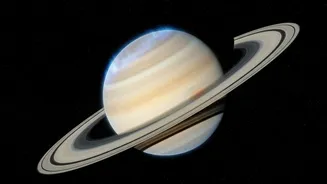
A new analysis of years of Cassini data has provided a breakthrough. It confirms a long-held theory: on giant, fast-spinning planets like Saturn, the planet's own rotation and the material it drags along can overpower the Sun's influence. Saturn spins incredibly fast, completing a day in about 10.7 hours, and it's constantly supplied with a huge cloud of charged water particles from the geysers on its icy moon, Enceladus. This combination creates a powerful internal dynamic. The planet’s rapid spin essentially flings this plasma outward, stretching and twisting the magnetic field into an uneven, lopsided shape.
Finding the Cusp
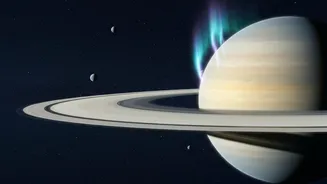
Researchers focused on a key feature called the magnetospheric cusp. This is a funnel-like opening near a planet's poles where solar particles can enter the atmosphere, creating auroras. On Earth, this cusp is reliably located on the side of the planet facing the Sun, around noon. However, the new analysis of Cassini data shows that Saturn's immense rotational force drags its cusp far into the afternoon, sometimes as late as 8:00 PM local time. This significant displacement is direct evidence of the magnetosphere's distortion. This lopsided structure explains the confusing PPO signals, as different parts of the magnetosphere are rotating at slightly different speeds, creating multiple, shifting 'heartbeats' that have baffled scientists for decades.
Why This Discovery Matters
Understanding this distortion fundamentally changes how scientists view giant planets. It shows that Saturn’s environment is driven more by its own powerful engine than by the solar wind, a key difference from Earth. This knowledge is crucial for interpreting Saturn's vibrant auroras and understanding how high-energy particles are accelerated within its system. It also provides a vital new framework for studying the thousands of gas giants discovered outside our solar system, suggesting that many may have similarly complex, internally driven magnetospheres. The findings are a testament to the Cassini mission, whose data continues to yield profound insights long after its operational life.