

The Ever-Shifting Earth
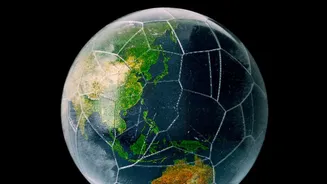
Our planet's surface is a dynamic puzzle of tectonic plates that are constantly in motion, floating on the semi-molten mantle beneath. This movement, known as plate tectonics, drives the continents to drift, collide, and break apart over vast geological
timescales. This process operates in a grand pattern called the supercontinent cycle, where landmasses periodically gather into one giant continent and then break apart again over hundreds of millions of years. The most famous of these was Pangaea, which existed around 300 million years ago before splintering to form the continents we know today. We are currently in the middle of a cycle, with the continents drifting apart after Pangaea's breakup. But the cycle continues, and scientists are now using advanced models to predict what the next gathering will look like.
Introducing Amasia: The Next Supercontinent
Several theories exist about how the next supercontinent will form, with names like Pangaea Proxima and Aurica proposed. However, a leading model, supported by supercomputer simulations, predicts the formation of 'Amasia'. The name is a portmanteau of America and Asia, as these two continents are expected to be the central players in the new landmass. This scenario suggests that instead of the Atlantic Ocean closing (which would essentially reform Pangaea), the much older Pacific Ocean will be the one to disappear. Research from Curtin University suggests this will happen in the next 200 to 300 million years. Australia is also predicted to play a key role, first colliding with Asia before the Americas bridge the gap.
How the Pacific Will Close
The Pacific Ocean is already shrinking by about an inch each year. This is happening because of subduction zones—often called the 'Ring of Fire'—that encircle the ocean. In these zones, the dense oceanic plate is forced underneath the lighter continental plates, slowly being consumed by the Earth's mantle. Meanwhile, the Atlantic Ocean is widening due to the Mid-Atlantic Ridge, a massive underwater mountain range where new crust is being formed, pushing the Americas westward. This westward drift of the Americas, combined with the shrinking of the Pacific, sets the stage for a future collision with Asia. This specific model of formation is known as 'extroversion'—the closing of the external superocean (the Pacific was once part of the Panthalassa superocean that surrounded Pangaea).
A World Vastly Different
What would a world with Amasia be like? Geologists predict a planet dramatically different from our own. According to some models, the continents will converge over the North Pole, closing off the Arctic Ocean. The formation of such a massive single landmass would have profound effects on global climate. Supercontinents tend to have vast, arid interiors with extreme temperatures because they are so far from the moderating influence of oceans. Sea levels would likely be lower, and the immense landmass would alter ocean currents and weather patterns entirely. One study modeling a future supercontinent suggested it could become inhospitable for many mammals due to extreme heat and aridity.
Why This Prediction Matters
While a 200-million-year forecast has no bearing on our daily lives, it is a crucial part of understanding Earth as a living, evolving system. These models help scientists test their knowledge of the fundamental forces that shape our planet, from mantle convection to the strength of the lithosphere. By simulating how supercontinents form, researchers can refine their understanding of plate tectonics and the long-term carbon cycle, which regulates Earth's climate. It's a reminder that the world map is not fixed. The ground beneath our feet is part of a slow, powerful dance that has been going on for billions of years and will continue for billions more, constantly reshaping the face of our world.