






The Hidden Damage in Your Wash Routine
It seems counterintuitive, but the very act of washing your hair can be a stressful event for each strand. When hair gets wet, it swells as it absorbs water. Then, as it dries, it contracts. This repeated cycle of swelling and contracting is known as hygral
fatigue. Over time, this process can weaken the hair's protective outer layer, the cuticle, making it more prone to lifting and breaking. Furthermore, shampoos are designed to cleanse, but some can strip away not just dirt and oil but also essential proteins from within the hair shaft. This protein loss leaves hair weaker, more porous, and susceptible to breakage and split ends.
Coconut Oil’s Unique Protective Power
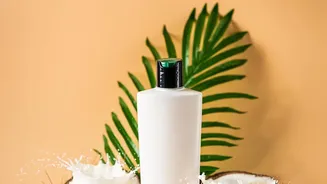
Not all oils are created equal when it comes to hair care. While many oils simply coat the surface of the hair, coconut oil has a unique molecular structure that sets it apart. It is rich in a medium-chain fatty acid called lauric acid. Due to its low molecular weight and straight linear chain, lauric acid is small enough to penetrate deep inside the hair shaft, rather than just sitting on top. In contrast, oils like sunflower and mineral oil have bulkier structures that can't be readily absorbed by the hair fiber. This ability to get inside the hair is what gives coconut oil its protective advantage.
How a Pre-Wash Treatment Works
When applied before shampooing, coconut oil acts as a protective shield from the inside out. By penetrating the hair shaft, it essentially waterproofs the strand, reducing how much water it can absorb during washing. This minimizes the damaging swelling-and-contracting cycle of hygral fatigue. More importantly, studies have shown that coconut oil has a high affinity for hair proteins. It binds to the keratin within the hair, significantly reducing the amount of protein that gets stripped away during shampooing. One well-regarded study found that, compared to mineral and sunflower oils, coconut oil was the only one that remarkably reduced protein loss in both damaged and undamaged hair when used as a pre-wash treatment.
Your Step-by-Step Guide to Pre-Pooing
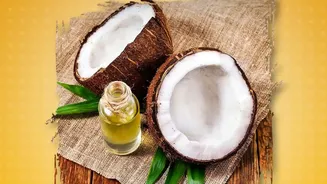
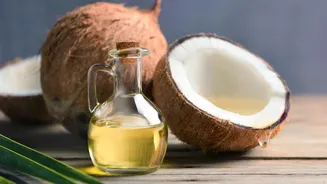
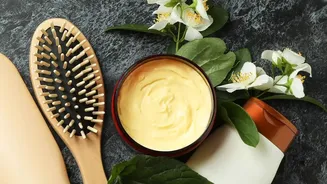
Incorporating this technique into your routine is simple. Start with dry hair, as applying the oil before it gets wet is key to preventing water absorption. Take a small amount of virgin or unrefined coconut oil and warm it between your palms until it liquefies. Gently massage it through your mid-lengths and ends, which are the oldest and most fragile parts of your hair. You can apply it to your scalp, but if you have fine or oily-prone hair, you may want to focus only on the lengths to avoid weighing your roots down. Let the oil sit for at least 30 minutes; for a deep treatment, you can even leave it on overnight. Afterward, simply shampoo and condition as you normally would. You may need to shampoo twice to fully remove the residue.
Is It Right for Your Hair Type?
While this treatment is beneficial for many, it's particularly helpful for hair that is dry, damaged, colour-treated, or porous. These hair types are more susceptible to protein loss and hygral fatigue. However, coconut oil might not be for everyone. Those with very fine, low-porosity, or protein-sensitive hair may find that it feels heavy, greasy, or even makes their hair feel stiff and brittle. If you have coarse or curly hair, this method can be especially effective at locking in moisture and defining your curl pattern. As with any new treatment, it's wise to start with a small amount and see how your hair responds.