







Decoding the Travel Riddle
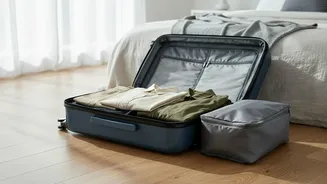
The headline isn’t a physics principle or a complex mathematical formula. It’s the core philosophy behind one of the most effective packing strategies ever devised: the 5-4-3-2-1 method. This system promises to fit a week's worth of diverse outfits into
a single carry-on, and it all starts with that counterintuitive idea. The 'Tops' and 'Bottoms' are exactly what they sound like: shirts and pants. The 'work' they do is creating a versatile, mix-and-match wardrobe that feels expansive, not restrictive. The rule is a framework for building a travel capsule wardrobe where every single piece earns its place in your suitcase by being compatible with almost everything else.
The Magic of Combinations
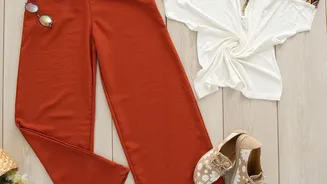
Here’s where the real genius of the system lies. The phrase 'pair with all four bottoms' is the non-negotiable rule that makes the whole thing click. Many of us pack in 'outfits,' but the 5-4-3-2-1 method forces you to pack in 'components.' If each of your five tops can be worn with each of your four bottoms, you haven't packed nine pieces of clothing; you’ve packed twenty possible combinations (5 x 4). Suddenly, a small selection of clothes offers enough variety for a week or more without a single repeat outfit. The trick is choosing pieces that share a complementary color palette. You don't have to stick to bland neutrals, but your chosen tops and bottoms must all get along. A top that only works with one specific pair of pants is a waste of precious luggage space.
The Full 5-4-3-2-1 Breakdown
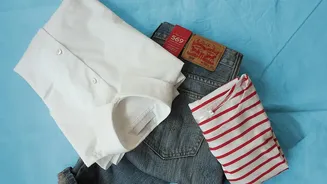
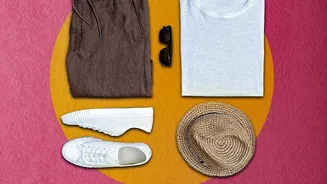
While the tops and bottoms do the heavy lifting, the rest of the formula provides structure for your entire suitcase. It breaks down like this: Five Tops: This is where you get your variety. Pack a mix of T-shirts, blouses, or lightweight knits that can be dressed up or down. Think versatile styles that work for different occasions. Four Bottoms: This forms the foundation. A good mix might include one pair of jeans, one pair of smarter trousers or a skirt, and perhaps a pair of shorts, depending on your destination. Three Pairs of Shoes: This is often the hardest part for over-packers. The rule suggests one comfortable walking shoe, one dressier option, and one casual sandal or trainer. You wear the bulkiest pair on the plane. Two Layers or Bags: This category is flexible. It could mean two layering pieces like a cardigan and a light jacket, or it could be one handbag and one daypack. It's about practical additions. One Accessory Set: This final slot is for the extras. It might be a hat and sunglasses, a favorite scarf, or a swimsuit. It’s the climate-dependent essential that completes your kit.
How to Make the System Work for You
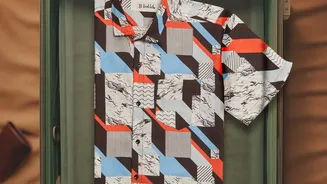
Successfully using this method requires a little planning before you even open your closet. Start by checking the weather at your destination and considering your itinerary. What activities will you be doing? Then, lay out your potential items on your bed and test the combinations. Does that striped shirt really work with the floral skirt and the jeans? Be honest with yourself. If a piece is a 'maybe,' it's a 'no.' Building your capsule around a core color family—like navy, cream, and green or black, grey, and burgundy—makes mixing and matching almost foolproof. The goal isn't to create a boring wardrobe, but a cohesive one. Remember, you can always add personality with your two accessories or a brightly colored top. This method is a guideline, not a rigid law. If you don't wear skirts, bring two pairs of trousers and two pairs of shorts instead. The numbers can be adjusted, but the principle of radical compatibility remains the same.