




The Vision of Abundance
In recent statements made in July 2026, Elon Musk articulated a future where AI and robotics create such a surplus of goods and services that the very concept of money could become obsolete within a decade. He imagines an economy where machines can produce
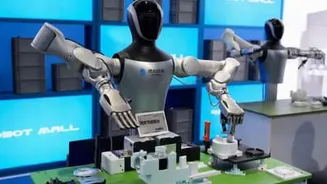
more than humanity could reasonably consume, shifting the primary economic challenge from managing scarcity to managing abundance. This isn't just about digital goods; Musk's vision hinges on humanoid robots extending AI's intelligence into the physical world—factories, farms, and homes—drastically reducing the cost of everything from housing to food. He has described this as an age of amazing abundance where anyone can have anything they can think of, a fundamental transformation of civilization.
What 'Post-Scarcity' Actually Means
The core idea Musk is tapping into is 'post-scarcity,' a concept long explored in science fiction and economics. Traditionally, economics is the study of how we allocate limited resources. A post-scarcity economy, enabled by AI, would theoretically solve this fundamental problem. If AI and robots can handle production with near-zero marginal cost, the need for labor to earn money to buy necessities could disappear. Proponents argue this could lead to a world without poverty, where universal needs are met automatically. The focus of human life could shift from economic contribution to self-expression, creativity, and community. However, this transition is fraught with challenges, as it disrupts the entire basis of our current social and economic systems.
The Technology Behind the Dream
For Musk's vision to materialize, several technological leaps are required. The first is achieving Artificial General Intelligence (AGI), or AI that can perform nearly every intellectual task better than a human. Musk himself predicts AI could surpass combined human intelligence within five years. The second component is advanced robotics, like Tesla's own Optimus project, to translate AGI's digital instructions into physical action. A major hurdle, as Musk has acknowledged, is the limitation of training data. AI models have nearly exhausted the internet's public data, meaning future progress will rely on AI generating its own 'synthetic data' to learn from—a process with its own risks of creating a feedback loop of errors.
Hurdles on the Path to Utopia
Critics and even cautious proponents point to significant barriers. The most immediate is the 'transition problem': mass job displacement caused by AI could lead to severe economic turmoil and social unrest long before any utopian abundance is achieved. Studies already show that workers in occupations most exposed to AI are experiencing negative employment impacts. Another major concern is the 'control problem': who owns and controls the AI? If a handful of corporations or individuals control the means of AI production, it could lead to an unprecedented concentration of wealth and power, creating a new kind of feudalism rather than shared prosperity. As venture capitalist Vinod Khosla notes, ensuring the benefits are equitably distributed will require proactive political policies.
The Human Element in an Automated World
Beyond the economic and technical challenges lies a profound philosophical question: what is the meaning of human life in a world without work? While the promise of being free from labor is appealing, some sociologists and philosophers warn of a potential 'meaning crisis'. For centuries, work has provided not just income but also structure, purpose, and identity for many. Eliminating it could lead to widespread existential angst and social destabilization. The debate also touches on whether AI, programmed for efficiency, can align with human values and ethics. Ultimately, the path to an AI-driven future depends not just on what the technology can do, but on the choices humanity makes about how to use it.