




A Galaxy Knocked Sideways
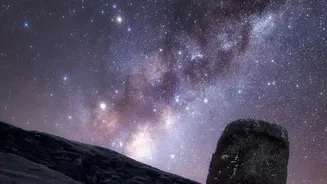
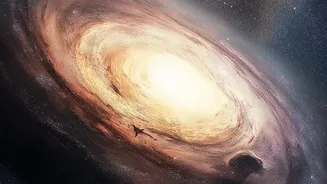
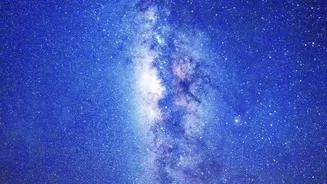
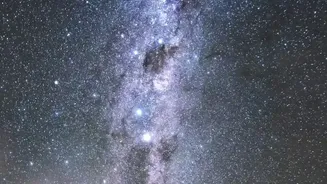
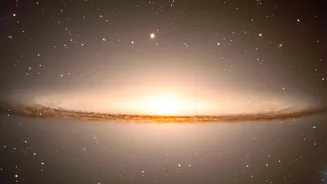
When we picture the Milky Way, we imagine a vast, flat, spinning disc. For the most part, that's accurate. The vast majority of its stars, including our Sun, orbit within this disc. But how is that disc oriented? The concept of a galaxy 'flipping' sounds
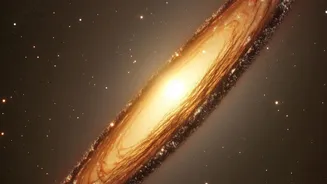
like science fiction, but it refers to a dramatic change in the orientation of this galactic disc within its much larger, spherical halo of dark matter. Recent supercomputer simulations from Durham University suggest that a sufficiently powerful head-on collision could provide enough gravitational torque to slowly, over hundreds of millions of years, tilt the entire disc by more than 90 degrees. It’s less like a quick somersault and more like a massive, slow-motion wobble that eventually settles into a new orientation.
Cosmic Detective Work
This startling theory didn't come out of nowhere. It began with a long-standing puzzle. Surrounding the Milky Way’s fast-spinning main disc is a sparse, larger sphere of older stars called the stellar halo. For years, astronomers were baffled because observations showed this halo rotates incredibly slowly, a stark contrast to the disc itself. The key to unlocking this mystery came from the European Space Agency's Gaia mission. By creating an unprecedented 3D map of the positions and movements of billions of stars, Gaia provided the data needed to piece together our galaxy's tumultuous past. Researchers used this data to run simulations, looking for events that could explain the halo's sluggish spin.
The Prime Suspect: Gaia-Sausage-Enceladus
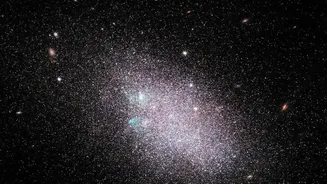
The simulations pointed to a single, cataclysmic event: a major, head-on merger. Conveniently, astronomers already knew about one. Thanks to earlier Gaia data, the culprit was identified in 2018 as a massive dwarf galaxy now known as Gaia-Sausage-Enceladus (GSE). The name comes from the sausage-like shape of its debris stars' orbits in velocity space. About 10 to 11 billion years ago, long before the Earth formed, the GSE galaxy slammed into the young Milky Way. Though smaller than our galaxy, it was huge, carrying the mass of over 10 billion suns in stars, gas, and dark matter. The Milky Way tore it to shreds, absorbing its contents. This event is considered our galaxy's last major merger, fundamentally reshaping it and creating much of the stellar halo we see today.
A New Chapter in Our Galactic Story
The new research presented at the 2026 National Astronomy Meeting provides the crucial link: the computer models showed that galaxies like ours that experienced a massive head-on collision like the GSE merger were also likely to have their disc flipped. This provides a compelling explanation for the halo’s slow rotation. The violent merger essentially scrambled the galaxy's original orientation, leaving the halo with very little net rotation while the disc eventually re-formed and settled into its current plane. This theory changes our understanding of how the Milky Way assembled and evolved. It suggests our galactic home has been far more dynamic and chaotic than previously thought. Finding that its disc likely flipped adds a profound new chapter to its biography.