






The Hidden Cost of Our Favourite Treats
A perfect cookie requires perfect ingredients, but the supply chains for many baking staples are surprisingly fragile and damaging. Vanilla, for instance, largely comes from a few specific regions, making it vulnerable to weather and price shocks. Palm
oil, a common fat in processed foods for its unique texture, is a major driver of deforestation in tropical regions. Even chocolate has a dark side, with cocoa farming linked to environmental degradation and labour issues. These challenges are forcing food producers to look for alternatives that are not only cheaper and more reliable but also kinder to the planet. The current system, reliant on traditional agriculture, is straining under the pressure of a growing global population and a changing climate.
Enter the Microbe: A Tiny Factory for Food
The solution might sound like science fiction, but it's a process that humans have used for centuries: fermentation. Researchers are now taking this ancient technique to a new level with what is called “precision fermentation.” Think of it like a microscopic brewery. Scientists give a microorganism, like yeast, a specific set of genetic instructions—a recipe, in a way. This programs the microbe to consume simple sugars or other feedstocks and convert them into a specific, desired molecule. Instead of brewing alcohol, these tiny factories can be instructed to produce proteins identical to those in eggs or milk, fats with the properties of cocoa butter, or the exact flavour compounds that make vanilla taste like vanilla. The process happens in controlled, enclosed vats, removing the need for vast tracts of land.
From Vanilla Flavour to Sustainable Fats
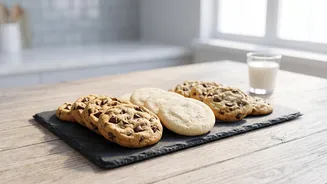
So, which parts of the cookie could be made this way? The possibilities are expanding rapidly. Vanillin, the primary component of vanilla flavour, is a popular target and can be produced by engineered yeast. This offers a stable alternative to sourcing it from plants. Fats and oils are another major frontier. Companies like Melt&Marble and Nourish Ingredients are developing microbial fats designed to mimic the texture and mouthfeel of animal fats or palm oil, which could revolutionize not just cookies but plant-based meats and dairy as well. In a fascinating recent development, researchers at Southern Illinois University demonstrated they could even break down plastic waste (PET) and agricultural residue, then feed the resulting carbon molecules to yeast to produce proteins, fats, and even beta-carotene (a precursor to Vitamin A). They then 3D-printed a prototype cookie, called a µBite, to prove the concept.
The Hurdles Before Lab-Grown Cookies Hit Shelves
While the science is promising, don't expect to find microbe-made cookies in your local supermarket tomorrow. The biggest challenge is scale. Taking a process that works in a small lab and making it efficient enough to produce ingredients on an industrial scale is a massive technical and financial hurdle. The energy required to run large fermentation facilities is also a significant consideration, potentially offsetting some of the environmental benefits if not powered by renewable sources. Cost is another factor; producing a kilogram of the material for the experimental µBite cookie, for example, currently costs around $60. Finally, there's consumer acceptance. Companies will need to convince shoppers that ingredients produced by programmed yeast are safe, natural, and desirable. Although the technology has been used safely for decades to make things like insulin and cheese-making rennet, the idea of “lab-grown” food can still make people uneasy.