






The Workhorse Rocket Delivers
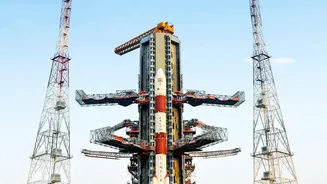
The star of the show on launch day was the Geosynchronous Satellite Launch Vehicle (GSLV), in its GSLV-F17 configuration. Standing 51.7 metres tall, this three-stage rocket is one of ISRO's most powerful launch vehicles, designed to carry heavier satellites
into high-energy orbits. Its first stage uses a powerful solid propellant motor augmented by four liquid-fueled strap-on boosters to provide the immense initial thrust. After that, a liquid-fueled second stage takes over. For years, the GSLV was nicknamed the "Naughty Boy" due to a mixed record in its early development phase. However, with a string of successful flights, it has matured into a reliable workhorse. This launch was particularly significant as it marked a comeback after the GSLV-F10 mission carrying the similar EOS-03 satellite failed in 2021 due to an issue with the final stage. The success of F17 proves the robustness of the vehicle and the meticulous work done by ISRO engineers to overcome past challenges.
A Masterclass in Cryogenic Power
The most crucial part of the GSLV's journey is its third and final stage: the Cryogenic Upper Stage (CUS). This is where the real magic of advanced rocket science comes into play. Cryogenic engines use super-cooled liquid hydrogen and liquid oxygen as propellants. While incredibly efficient and powerful, this technology is also immensely complex to master due to the extremely low temperatures required. Only a handful of nations have developed their own cryogenic engine technology, and India is one of them. The indigenous CE-7.5 engine powers the GSLV's upper stage, providing the final, decisive push needed to inject the satellite into a precise Geosynchronous Transfer Orbit (GTO). This capability is vital for self-reliance, as it allows ISRO to launch heavy communication and observation satellites without depending on foreign launch providers.
EOS-05: India's New Eye in the Sky
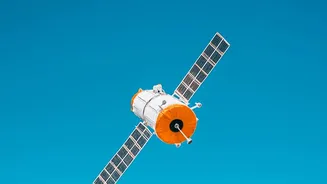
The precious cargo aboard the GSLV-F17 was the EOS-05, a state-of-the-art Earth observation satellite weighing approximately 2,367 kg. Unlike most observation satellites that orbit closer to Earth, EOS-05 is designed for a geosynchronous orbit at an altitude of about 36,000 kilometres. From this high perch, the satellite's speed matches the Earth's rotation, allowing it to seemingly hover over the Indian subcontinent. This provides a persistent, real-time view of a vast geographical area. EOS-05 is equipped with advanced imaging sensors capable of monitoring weather patterns, land use, and environmental changes. Its primary goal is to provide rapid monitoring of natural disasters like cyclones, floods, and forest fires, offering data that can be crucial for timely emergency response.
The Journey to Final Orbit
The launch itself, which took place from the Satish Dhawan Space Centre in Sriharikota, was just the beginning of the satellite's journey. The GSLV-F17's job was to deliver EOS-05 into a Sub-Geosynchronous Transfer Orbit (Sub-GTO), an elliptical path around the Earth. The rocket accomplished this task flawlessly in a flight lasting about 18 minutes. From there, the satellite takes over. Over the next several days, ISRO's mission control will perform a series of complex orbit-raising manoeuvres. Using its own onboard propulsion system, EOS-05 will fire its thrusters at precise moments to gradually raise its orbit and make it more circular, eventually reaching its final destination in the geosynchronous slot. Once in position, its solar panels and antennas will be deployed, and after a period of rigorous testing, it will be declared operational and begin its mission of watching over India.