




A New Security Triangle
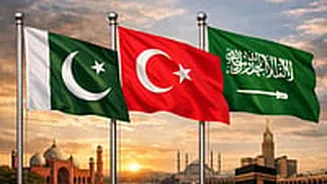
Signed on August 7, 2026, the Mecca Joint Defence Agreement establishes a principle of collective security: an armed attack on one of the three signatories shall be regarded as an attack on all. This brings together three of the most influential powers
in the Muslim world: Saudi Arabia, with its immense economic resources and religious significance; Türkiye, a NATO member with a sophisticated defence industry; and Pakistan, the sole nuclear-armed state in the Muslim world. The pact builds on a previous bilateral agreement between Saudi Arabia and Pakistan and formalises a deeper, more structured cooperation. While officials have compared the mutual defence clause to NATO's Article 5, analysts note that crucial details on command structures and force commitments remain undefined, making it more of a powerful political signal than a fully operational military alliance at this stage. The choice of Mecca for the signing carries immense symbolic weight, aiming to bestow popular legitimacy on the agreement across the Islamic world.
A Shift Away From Dependence
The Mecca Pact is widely seen as a direct response to a changing regional security environment and growing doubts about the reliability of the United States as a sole security guarantor. For years, Gulf states have relied on the American security umbrella. However, events like attacks on Saudi oil infrastructure and a perceived unpredictability in US foreign policy have pushed regional powers to diversify their partnerships. This agreement is less about replacing the US-led order and more about preparing for a pluralistic one, where regional powers take a leading role in producing their own security rather than just consuming it. It represents a move toward 'strategic autonomy,' where nations build overlapping alliances to ensure that the weakness of one security guarantee is offset by the strength of another. This allows Riyadh to maintain its partnership with Washington while simultaneously deepening defence ties with Ankara and Islamabad.
Impact on the Gulf Cooperation Council
The new trilateral alliance introduces a complex dynamic for the Gulf Cooperation Council (GCC). For decades, the GCC's security posture was largely defined by a collective alignment against Iran, with the US as a backdrop. The Mecca Pact, however, is a Saudi-led initiative that sits outside the traditional GCC framework. Other GCC members, like the United Arab Emirates, which has pursued its own distinct foreign policy and is a signatory to the Abraham Accords, are not part of this new pact. This could lead to a multi-tiered security architecture in the Gulf, where Saudi Arabia operates within both the GCC and the new Mecca framework. While the pact aims to deter aggression in the region, including from Iran and its proxies, it could also highlight internal GCC divisions, as member states weigh their individual relationships with Türkiye, Pakistan, and the United States.
Recalibrating the Abraham Accords
The Mecca Pact significantly alters the strategic environment surrounding the Abraham Accords, the series of normalisation agreements between Israel and several Arab nations. For years, bringing Saudi Arabia into the Accords was considered the ultimate diplomatic prize, a move that would reshape the region. This new pact complicates that vision. By creating an alternative, powerful security framework with two major non-Arab Muslim nations, Saudi Arabia reduces its dependency on a potential normalisation deal with Israel as the primary path to security. It does not necessarily close the door on an eventual Saudi-Israeli agreement, but it changes the bargaining power. Riyadh now has more strategic options and is less reliant on the US-backed Accords framework, signalling that any future normalisation will happen on terms that are more aligned with its own diversified security interests.