


A Star in Extreme Close-Up
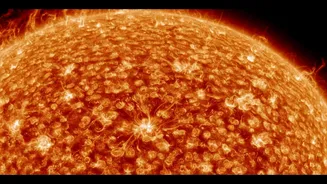
The image causing a stir in the scientific community reveals a pattern resembling boiling liquid or kernels of corn. These are solar granules, and what we're seeing is the Sun’s surface in mind-boggling detail. Taken by the National Science Foundation's
Daniel K. Inouye Solar Telescope in Hawaii, the image resolves features on the Sun as small as 19 kilometres across. While the headline attributes this to NASA, it's a collaborative world in space science; NASA's Astronomy Picture of the Day featured the image, highlighting its significance, and the agency's scientists will use the data to complement findings from its own solar missions like the Parker Solar Probe and Solar Dynamics Observatory. The image shows the tops of massive convection cells, each one roughly the size of a country like Mexico or Indonesia, constantly bubbling and shifting.
The Science of Solar Granules
So, what are these 'granules'? They are the visible tops of convection currents, similar to the bubbling in a pot of boiling water, but on a colossal scale. Hot plasma from the Sun's interior rises in the bright centre of these granules. As it reaches the surface, it spreads out, cools, and sinks back down along the darker, cooler lanes between them. This entire process is remarkably fast; a single granule lasts for only about eight to 20 minutes before it dissipates and is replaced by a new one. At any given moment, the Sun's surface is covered by about four million of these churning cells, a testament to the constant and violent energy transfer happening within our star.
Technology That Stares at the Sun
Capturing such an image is a monumental technological feat. The Daniel K. Inouye Solar Telescope is the most powerful solar telescope on Earth, boasting a massive four-metre primary mirror that collects more sunlight than any other solar instrument. This power allows it to achieve unparalleled resolution. Observing the Sun presents unique challenges, primarily the immense heat and light. The telescope employs a sophisticated cooling system and adaptive optics, which are computer-controlled deformable mirrors that correct for the blurring caused by Earth's atmosphere. This technology is what makes it possible to see the Sun's surface so clearly from the ground, revealing dynamic processes like the newly confirmed Kelvin-Helmholtz instability—swirling vortices that were long theorized but never directly observed until now.
Why This Fiery Detail Matters
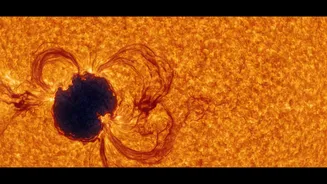
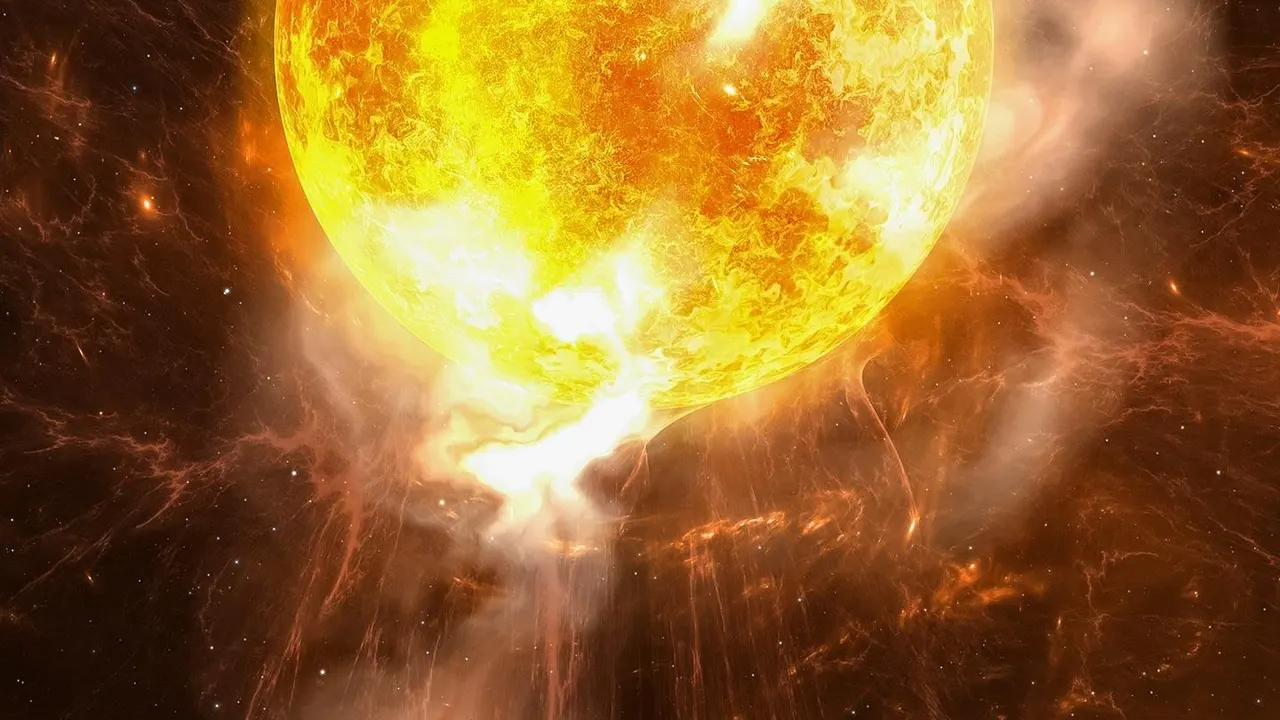
These images are far more than just pretty pictures. Studying the behaviour of granules and the magnetic fields that thread through them is crucial for understanding the Sun's physics. This process of convection is the engine that drives much of the Sun's activity, including the creation of sunspots and solar flares. This activity, in turn, generates space weather—a stream of charged particles and radiation that flows from the Sun. Powerful solar events can have significant effects on Earth, disrupting communication satellites, damaging power grids, and posing a risk to astronauts. By understanding the fundamental processes on the Sun's surface, scientists can improve their models and better predict space weather, giving us the chance to protect our vital infrastructure.