


A Glimpse into a Star's Ghost
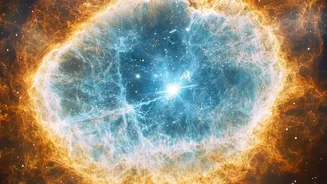
Located about 6,500 light-years away in the constellation Gemini, NGC 2392 is a planetary nebula. But the name is a bit of a historical misnomer; it has nothing to do with planets. Early astronomers like its discoverer, William Herschel, thought these
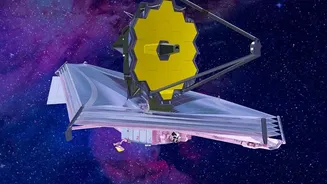
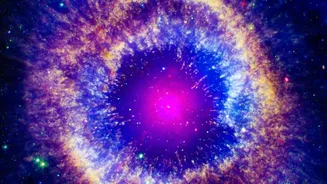
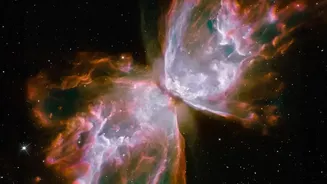
round, glowing objects resembled planets through their small telescopes. In reality, a planetary nebula is the spectacular remnant of a Sun-like star that has reached the end of its life. When such a star runs out of nuclear fuel, it sheds its outer layers of gas into space. These ejected layers form intricate, glowing shells around the star's tiny, hot core. The new image from the James Webb Space Telescope (JWST) captures this process in stunning detail, showing structures that have been evolving for several thousand years.
The Power of Webb's Infrared Eyes
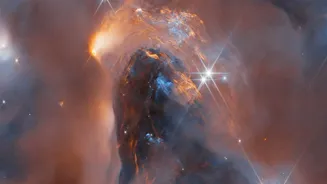
While the Hubble Space Telescope gave us remarkable views of NGC 2392 in visible light, Webb's strength lies in its ability to see the universe in infrared. This allows it to peer through clouds of cosmic dust that would otherwise obscure our view. For NGC 2392, Webb used both its Near-Infrared Camera (NIRCam) and Mid-Infrared Instrument (MIRI) to create a composite image that reveals hidden features. The infrared data highlights dense concentrations of dust and hazy regions of ionized gas with greater clarity than ever before. What appears in visible light as a fuzzy outer region is revealed by Webb to be a complex structure of dust and gas, with clumps that have so far survived the intense radiation from the central star.
The 'Lion Nebula' and Its Fiery Heart
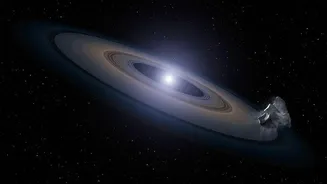
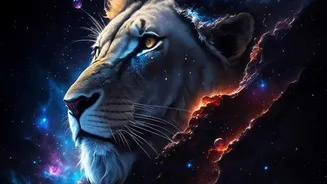
The nebula's appearance has earned it the nickname the Lion Nebula, with the central star resembling a lion's nose and the surrounding structures forming its face and mane. At the very center of this cosmic artwork is the culprit behind the chaos: a white dwarf. This is the incredibly hot and dense remnant of the original star's core. Despite its small size, this white dwarf unleashes a torrent of radiation and powerful stellar winds. The radiation is so intense it heats the surrounding gas, causing it to glow and expand, carving out the bubble-like 'face' of the lion. This process is destructive, destroying some of the dust it encounters while illuminating the rest.
A Cosmic Preview of Our Sun's Future
Studying planetary nebulae like NGC 2392 isn't just about admiring their beauty; it's a way for scientists to understand the life cycle of stars, including our own Sun. In about five billion years, our Sun is expected to go through a similar process, puffing off its outer layers to create its own planetary nebula. The leftover core will become a white dwarf. The complex shapes of these nebulae, with their jets, filaments, and shells, are a key area of astronomical research. Images from Webb help astronomers understand how the interplay between slow and fast stellar winds, radiation, and the surrounding material sculpts these celestial masterpieces. The structures seen in NGC 2392 are temporary; astronomers estimate the entire nebula will disperse into space in about 10,000 years, a relatively brief moment in cosmic time.
A Note on Names
NGC 2392 was previously known by another nickname, the 'Eskimo Nebula,' because of its resemblance to a face surrounded by a fur-lined parka. However, in 2020, NASA and other scientific bodies discontinued the use of this name, recognizing it as a colonial term that can be insensitive and harmful to the Indigenous peoples of Arctic regions. This move is part of a broader effort within the scientific community to ensure that the language used to describe the cosmos is inclusive and respectful to everyone.