




Why Your Desk Is a Back Pain Hotspot
Sitting for prolonged periods is a modern-day occupational hazard. When you're hunched over a keyboard, your spine is often in a state of sustained flexion, or forward bending. This puts continuous pressure on the spinal discs and can lead to a cascade
of issues. The muscles in your back, especially the lower back, can become overstretched and weak, while the muscles in your chest and the front of your hips (hip flexors) become tight and shortened. This muscular imbalance pulls your posture out of alignment, contributing to stiffness, chronic aches, and reduced mobility. The very act of sitting disengages your core muscles, which are essential for supporting your spine. Without this support, the burden falls squarely on your back.
The Principles of a Back-Friendly Stretch
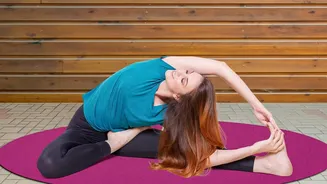
Before attempting any pose, it’s vital to understand what makes a stretch beneficial rather than harmful. The goal is to create gentle mobility and release tension, not to force your body into a pretzel. A truly back-friendly stretch is never painful; you should feel a mild pull, not a sharp or jolting sensation. Focus on slow, controlled movements and synchronise them with your breath. The aim is to counteract the posture you hold all day. Since we spend hours hunched forward, the best stretches often involve gentle backbends and twists to open the chest and mobilize the spine in different directions. Always listen to your body—if a stretch causes discomfort, ease off or stop.
Safe and Simple Stretches for Your Chair
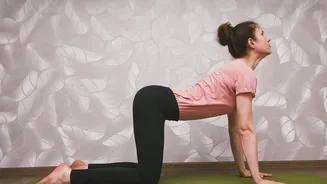
You don't need a yoga mat or a lot of space to give your spine some relief. These physiotherapist-approved stretches can be done right at your desk. 1. Seated Spinal Twist: Sit tall with your feet flat on the floor. Gently twist your torso to one side, using the armrest or back of the chair to deepen the stretch. Keep your hips facing forward. Hold for 20-30 seconds and repeat on the other side. This helps improve spinal mobility. 2. Seated Cat-Cow: Sit on the edge of your chair. As you inhale, arch your back and look up, opening your chest (Cow). As you exhale, round your spine and drop your chin to your chest (Cat). This gentle sequence promotes spinal flexibility. 3. Seated Figure-4 Stretch: Cross one ankle over the opposite knee. Sit up straight and gently lean forward until you feel a stretch in your hip and glutes. Hold for 20-30 seconds before switching legs. This helps release tight hips, which can pull on the lower back.
Poses to Approach with Caution
Not all yoga poses translate well to the office chair, especially for those with existing back pain. Deep, unsupported forward folds can put excessive pressure on the lumbar spine, particularly if a disc is already bulging. Similarly, intense backbends like Camel Pose or Full Wheel, which are sometimes attempted by avid practitioners, are risky without a proper warm-up and can compress the spine if done incorrectly. Aggressive twists where the movement comes from the lower back instead of the core can also strain vulnerable discs. If you are not an experienced practitioner, it's best to avoid poses that require significant core strength, like Boat Pose, as a weak core can cause you to dump pressure onto your back muscles.
Beyond the Stretch: Creating Better Habits
While stretching is beneficial, it's a small part of a larger solution. The most effective strategy to combat back pain is to reduce prolonged sitting. Experts recommend getting up to move for a few minutes every hour. Take a short walk, do some standing stretches, or simply stand up while on a phone call. Pay attention to your workstation ergonomics: ensure your monitor is at eye level, your chair supports your lower back's natural curve, and your feet are flat on the floor. These small, consistent adjustments in your daily routine will do more to protect your spine in the long run than a few isolated stretches can.