




A Journey That Redefined Pluto
It’s easy to forget that just over a decade ago, our best images of Pluto were fuzzy, pixelated blobs. That all changed in July 2015 when NASA's New Horizons spacecraft flew past the dwarf planet, fundamentally rewriting our understanding of this distant
world. Launched in 2006, the probe’s primary goal was to give humanity its first close-up look at the mysterious king of the Kuiper Belt. The data and images it sent back were breathtaking, revealing a complex and active world with towering mountains of water ice, vast nitrogen glaciers, a surprisingly complex atmosphere with potential haze and clouds, and a giant, heart-shaped plain. The encounter was a monumental success, transforming Pluto from a faint point of light into a vibrant, dynamic place.
An Encore in the Kuiper Belt
After its triumph at Pluto, New Horizons sailed onward into the Kuiper Belt, a vast, icy debris field of primordial objects left over from the formation of our solar system. On New Year's Day 2019, the spacecraft performed a daring flyby of Arrokoth, the most distant and primitive object ever explored by a spacecraft. This snowman-shaped relic, just 34 kilometres long, offered scientists an unprecedented glimpse into the gentle, low-speed conditions under which planetesimals—the building blocks of planets—are thought to have formed. This second act proved that New Horizons was more than a one-hit wonder; it was a unique tool for studying the solar system's ancient past.
A New Focus Until 2029
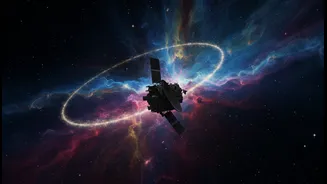
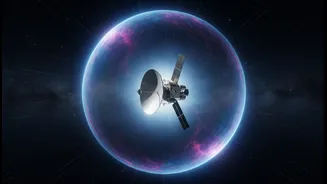
The mission's future recently came into focus after a period of uncertainty. NASA has officially extended operations until New Horizons exits the Kuiper Belt, which is expected to occur around 2028 or 2029. In this new phase, the mission will have a multidisciplinary focus. While the team continues to search for another Kuiper Belt Object (KBO) for a potential flyby, the primary task has shifted to heliophysics. The spacecraft is in a unique position to study the heliosphere—the giant magnetic bubble created by the Sun—from the outside in. This complements data from the Voyager probes and helps scientists understand the boundary where the Sun's influence ends and interstellar space begins.
The Challenge of Fading Power
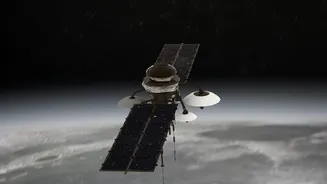
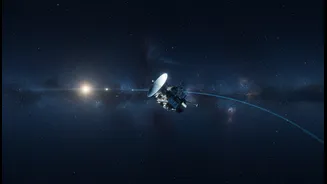
Keeping a spacecraft operational for decades, billions of kilometres from Earth, is no small feat. The biggest constraint for New Horizons is its power source: a Radioisotope Thermoelectric Generator (RTG). This device converts heat from the natural decay of plutonium into electricity. While reliable, its power output steadily declines over time. Mission operators must make careful decisions about which instruments to run to conserve energy. Principal Investigator Alan Stern has noted the craft has enough fuel and power to potentially operate for another 20 years, but as the power wanes, its capabilities will diminish. Even with power, its journey is a silent one; it must turn its entire body to point its main antenna back at Earth to send data, a process that takes hours due to the immense distance.
On the Brink of Interstellar Space
The ultimate fate of New Horizons is to join Voyager 1 and Voyager 2 as humanity's third interstellar messenger. While the formal mission is currently funded through the late 2020s, the spacecraft itself has enough power to continue transmitting data until at least the 2040s. After its instruments inevitably go dark, its journey will continue. It will silently coast through the Milky Way for millions, perhaps billions, of years, carrying mementos from Earth, including the names of over 434,000 people who signed up to have their names included on board. The decision to extend the mission ensures we can glean every last drop of science from this remarkable probe as it pushes the boundaries of exploration and prepares for its final, endless voyage into the void.