


A Cosmic Detective Story
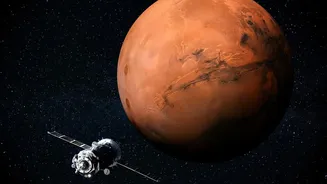
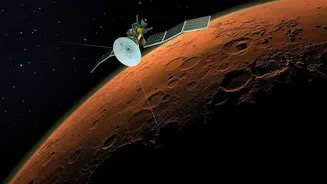
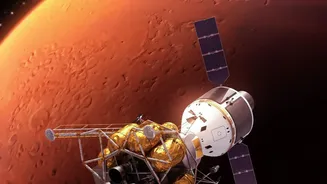
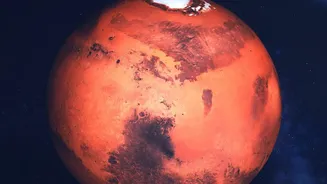
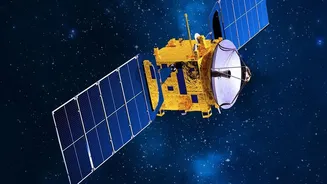
The Japan Aerospace Exploration Agency's (JAXA) Martian Moons eXploration (MMX) mission is a highly ambitious project to visit and, for the first time, return a sample from the surface of Phobos. Launched in October 2026, the spacecraft is on a year-long
journey to Mars, where it will spend about three years studying both moons before sending a capsule with at least 10 grams of Phobos's surface material back to Earth, with an expected arrival in 2031. This international collaboration, with contributions from NASA and European space agencies, aims to settle a long-standing debate with two competing theories.
Theory One: The Captured Wanderer
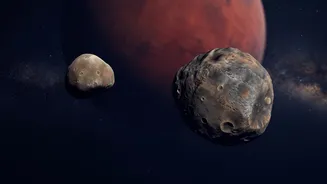
The first major theory suggests that Phobos and its sibling, Deimos, are captured asteroids. At first glance, this makes sense. Both moons are small, lumpy, and irregularly shaped, much like the asteroids found in the belt between Mars and Jupiter. Their dark surfaces also reflect light in a way similar to carbonaceous asteroids. However, this theory has a major problem: their orbits. Phobos and Deimos circle Mars in nearly perfect, equatorial orbits. Computer models struggle to explain how Mars's gravity could have captured passing asteroids and settled them into such orderly paths; they would be expected to have more random, eccentric orbits.
Theory Two: A Violent Birth
The second theory is much more dramatic: a giant impact. In this scenario, billions of years ago, a large object—perhaps the size of a small planet—smashed into a young Mars. The cataclysm would have blasted a massive ring of debris from the Martian surface into orbit. Over time, this material would have clumped together to form one or more moons. This 'giant impact' hypothesis neatly explains the moons' stable, circular orbits, much like how a similar impact is thought to have formed Earth's Moon. If this is true, Phobos would essentially be made of ancient Martian rock, mixed with material from whatever hit the planet.
How MMX Will Find the Answer
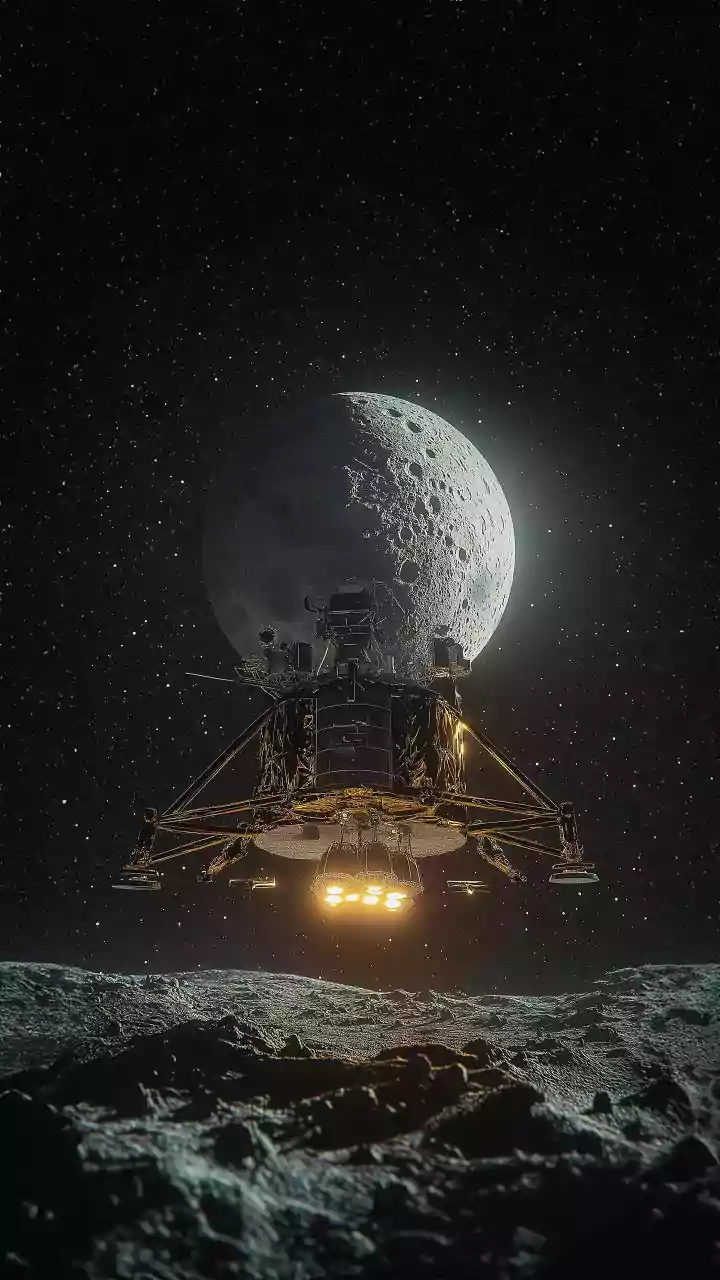
The MMX mission is equipped with a sophisticated suite of instruments to act as a cosmic detective. Upon arrival in 2027, it will first deploy a small French-German rover named 'Idefix' to scout the surface of Phobos. This initial survey will help mission controllers select a safe and scientifically interesting landing spot. The main MMX spacecraft will then descend and use two different sampling mechanisms—a coring drill and a pneumatic system that blows material into a collector—to grab its precious cargo. Before it even collects the sample, spectrometers like MEGANE (a NASA contribution) and MIRS will analyze the moon's surface composition from orbit, looking for key elements and minerals. If Phobos is a captured asteroid, its composition should resemble carbonaceous chondrites; if it's from an impact, it should be made of rock similar to Mars's crust.
Why This One Moon Matters So Much
Solving the origin of Phobos is about more than just one moon. If it's a captured asteroid, it could be a time capsule from the outer solar system, potentially carrying water and organic molecules that might have been delivered to a young Mars. This would have huge implications for understanding how the ingredients for life are distributed. On the other hand, if Phobos is made of Martian material, the returned sample would essentially be a sample of ancient Mars itself. Because Phobos is so close to Mars, its surface is expected to be coated in dust blasted off the planet by meteorite impacts over billions of years, offering a layered history of the Red Planet's evolution. The findings could completely reshape our understanding of how rocky planets and their moons form throughout the solar system.