




The Galaxy’s Ghostly Halo
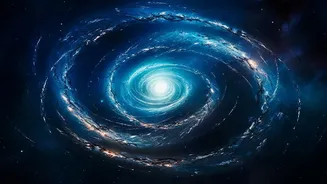
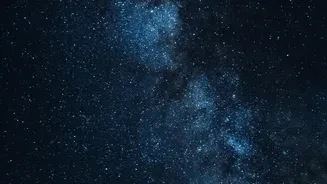
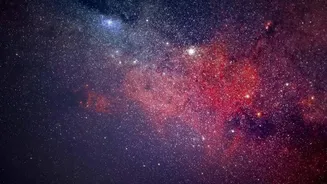
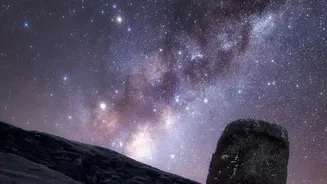
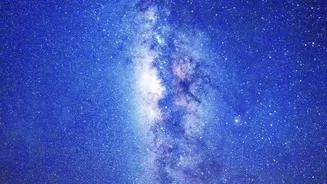
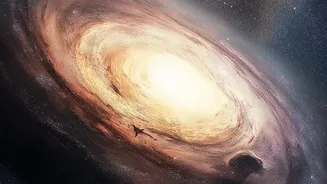
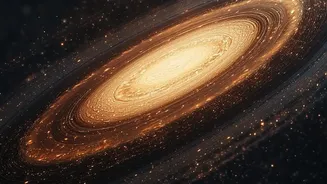
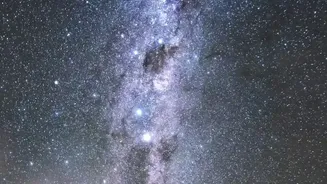
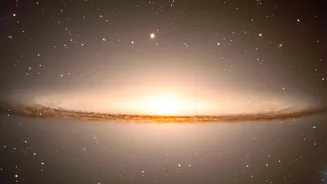
Most of the Milky Way’s hundreds of billions of stars reside in a relatively flat, spinning structure called the galactic disc. This is where our solar system lives. But surrounding this bustling disc is a vast, sparse sphere of ancient stars known as the stellar
halo. This halo is like a fossil record of our galaxy's history, primarily made up of stars captured from smaller galaxies that the Milky Way consumed over billions of years. Think of it as a faint, ghostly cloud enveloping the bright, pinwheeling city of stars at its core.
A Surprising Lack of Motion
Using data from the European Space Agency's Gaia mission, which is meticulously mapping the positions and movements of stars, astronomers noticed something strange. While stars in our disc zip around the galactic center at about 220 kilometers per second, the stars in the outer halo are barely moving, rotating at a comparatively glacial pace of 10 to 20 kilometers per second. This was a significant puzzle because computer models of galaxy formation typically predicted that this halo should be spinning much faster. The question for astronomers was: what could have put the brakes on an entire sphere of stars?
An Ancient, Violent Collision
The leading explanation points to a cataclysmic event deep in our galaxy's past. Researchers ran sophisticated supercomputer simulations to see what could cause such a slow-moving halo. The models showed that galaxies with the slowest halos had two things in common: they experienced a massive, head-on collision with another galaxy, and their disc subsequently underwent a dramatic flip, reorienting by more than 90 degrees. Astronomers already know the Milky Way had such a collision about 10 billion years ago with a dwarf galaxy now nicknamed the Gaia-Sausage-Enceladus. This merger was the most significant event in the Milky Way's early history, fundamentally reshaping it.
How a Merger Causes a Flip
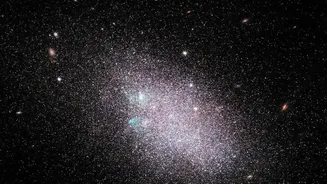
The Gaia-Sausage galaxy, while a 'dwarf', was still enormous, containing gas and stars with a mass of over 10 billion suns. When it smashed into the early Milky Way, the immense gravitational forces would have been transformative. The collision is thought to have scattered the stars from the dwarf galaxy into the chaotic, elongated orbits that now form much of our halo. According to the new simulations, the immense gravitational torque from such a merger could also have gradually tilted the entire galactic disc, causing it to flip over and settle into a new orientation within its dark matter halo over hundreds of millions or even billions of years. This violent re-shuffling would explain the slow rotation of the halo, as its stars retain the chaotic memory of the merger rather than a smooth, collective spin.
Rewriting Our Cosmic History
This discovery adds a dramatic new chapter to the story of our home galaxy. It suggests that the stable place we inhabit today is the result of a turbulent and transformative youth. The fact that the galactic disc may have flipped means that most of its stars, including possibly our own Sun, were once on completely different trajectories. It’s a powerful reminder that the cosmos is a dynamic place, and that even enormous structures like galaxies are constantly evolving. Piecing together this history, using clues hidden in the motion of ancient stars, helps astronomers understand not just our own galaxy's past, but how all spiral galaxies form and grow across the universe.