







Decoding the Martian Climate
Scientists from the Physical Research Laboratory (PRL) in Ahmedabad have charted some of the most extreme temperature variations ever recorded on the Martian surface. Their study reveals that temperatures can plummet to 150 Kelvin, or a bone-chilling
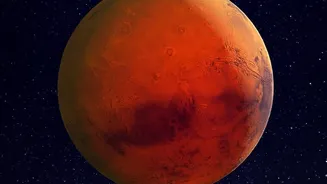
-123 degrees Celsius, and soar to nearly 295 Kelvin, a relatively balmy 22 degrees Celsius. These massive fluctuations are largely a result of Mars's incredibly thin atmosphere, which is about 100 times less dense than Earth's. This tenuous blanket of gas is unable to effectively trap and circulate heat, causing the surface to heat up rapidly under sunlight and lose that heat just as quickly when night falls. The findings paint a vivid picture of a world of stark thermal contrasts, far from the inert globe it can sometimes appear to be.
A Collaborative Cosmic Effort
This significant research was made possible by analysing data from an international partner. The PRL scientists utilized observations from the Emirates Mars Mission's 'Hope' spacecraft. Specifically, they harnessed the power of the Emirates Mars Infrared Spectrometer (EMIRS), an instrument designed to measure infrared radiation emitted from the planet. By focusing on two of Mars's largest impact basins, Hellas and Argyre, the Indian team was able to build a detailed map of how temperatures rise, fall, and ripple across the Martian landscape. This achievement highlights a growing trend in space science, where data from one nation's mission can be used by researchers worldwide to make new discoveries, fostering a collaborative spirit in our quest to understand the cosmos.
Riding the Zonal Waves
Beyond the sheer temperature range, the researchers uncovered large-scale patterns known as 'zonal waves'. Think of these like ripples on a pond; while you can't see the currents underneath, the patterns on the surface tell you a story about the forces at play. Similarly, these thermal waves provide an indirect window into Mars's atmospheric circulation. The study found a striking difference between the two basins investigated. The Argyre basin was dominated by a large-scale wave-1 pattern, whereas the deeper Hellas basin showed more complex wave-2 and wave-3 patterns that changed with the seasons. The scientists suggest that the immense depth and unique topography of these basins are instrumental in shaping these atmospheric wave patterns, demonstrating how geology and climate are deeply intertwined on Mars.
Why This Discovery Matters
Understanding Mars's thermal behaviour is not just an academic exercise; it has profound implications for the future of space exploration. Detailed climate models are crucial for planning future robotic and, eventually, human missions to the Red Planet. Knowing how temperatures fluctuate can help engineers design rovers, landers, and habitats that can withstand the extreme environmental stresses. Furthermore, the PRL team compared their observations to the existing Mars Climate Database. They found that while the model correctly predicted the general patterns, its temperature readings were often about 10 Kelvin cooler than what the EMIRS instrument actually measured. This discrepancy provides vital feedback that will be used to refine and improve our climate models, leading to safer and more effective missions in the years to come.