




Cosmic Neighbors or Distant Strangers?
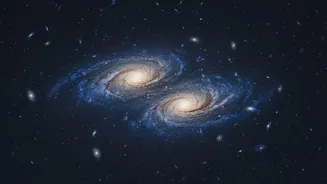
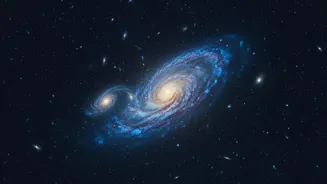
A recent image featured by NASA provides a beautiful and educational look at three distinct pairs of galaxies in the Centaurus Galaxy Cluster. At first glance, the image appears to show sets of cosmic neighbors, galaxies seemingly close enough to touch.
However, the story behind each pair is a fascinating lesson in the vastness of space and the difference between a true interaction and a chance alignment. Just because two objects appear side-by-side from our vantage point on Earth doesn't mean they are anywhere near each other. This concept of perspective is crucial for astronomers as they map the universe and try to understand the complex gravitational dances that galaxies perform across millions of years.
A Tale of Three Pairings
Each duo in the image tells a different story. The topmost pair features NGC 4650A, a striking polar-ring galaxy, whose unique structure might be the result of a past collision. Its apparent partner, however, is likely a background object, not currently interacting with it. The middle pair is another case of cosmic deception. While they appear gravitationally linked, their high relative speeds suggest they are merely passing ships in the cosmic night, not true companions. It's only the bottom pair, NGC 4622A and NGC 4622B, that are truly engaged in a gravitational tango. These two are actively interacting and are on a path to merge into a single, larger galaxy in about a billion years.
The Science of Seeing
Distinguishing between a chance alignment and a genuine interaction is a critical skill in astronomy. True interacting galaxies, like Arp 72, can be separated by what seems like a large distance—around 40,000 light-years at their closest point—but are close enough for gravity to distort their shapes, creating long streamers of stars and gas called tidal tails. In contrast, pairs like NGC 3314 feature one galaxy perfectly silhouetted against another, separated by tens of millions of light-years. These chance alignments are incredibly valuable. They allow astronomers to study the dust lanes in the foreground galaxy, which become visible as they block the light from the galaxy behind it. This provides a unique method for mapping the distribution of interstellar material.
Why These Illusions Matter
Understanding these cosmic lineups is about more than just appreciating a pretty picture. When astronomers study the large-scale structure of the universe, they need to know what they're looking at. Is that distorted galaxy being pulled apart by a neighbor, or did it just form that way? Is that flicker of light a single object or two distant ones perfectly aligned? These chance alignments, also known as conjunctions, can create gravitational lensing effects that magnify even more distant objects, providing a natural telescope for peering deeper into the early universe. Misinterpreting a simple lineup as a true merger could lead to incorrect conclusions about a galaxy's mass, evolution, and environment. These images force us to confront our own terrestrial biases about distance and reminds us that in space, things are rarely as they seem.