


The Challenge of Finding the Invisible
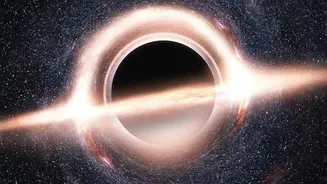
Black holes are the ghosts of the cosmos. Formed from the collapsed cores of massive stars, their gravitational pull is so powerful that nothing, not even light, can escape. This makes them incredibly difficult to detect. Astronomers estimate there could
be as many as 100 million stellar-mass black holes in our Milky Way galaxy alone, yet only a few dozen have been confidently identified. Most of those were found because they are not alone; they are actively 'feeding' on a nearby companion star, a messy process that heats gas to extreme temperatures and causes it to glow brightly in X-rays. But the vast majority of black holes are thought to be dormant and isolated, drifting silently through the galaxy without a companion. Finding these solitary wanderers requires a completely different and more subtle detection method.
A Cosmic Magnifying Glass
The key to finding these hidden giants lies in a phenomenon predicted by Albert Einstein called gravitational microlensing. Gravity warps the fabric of spacetime, and a massive object like a black hole creates a significant warp. When a black hole passes almost directly in front of a more distant star from our point of view, its gravity acts like a natural magnifying glass. It bends and focuses the light from the background star, causing it to appear temporarily brighter. This isn't just a simple flicker; it’s a specific pattern of brightening and fading as the alignment shifts, creating a distinctive peak in the star's light curve—a graph of its brightness over time. This gravitational clue allows astronomers to 'see' the invisible by observing its effect on the visible.
Enter the Black Hole Hunters
This is where the 'Black Hole Hunters' initiative comes in. It's a citizen science project that invites the public to help professional astronomers in this cosmic search. Hosted on the Zooniverse platform, the project uses a massive dataset from NASA's Transiting Exoplanet Survey Satellite (TESS). TESS was designed to find planets by monitoring the brightness of millions of stars, but its data is a goldmine for finding other transient events, including potential microlensing by black holes. Volunteers are shown light curves from TESS and asked to identify the characteristic peak shapes that might signal a black hole passing in front of a star. While computer algorithms can make a first pass, the human eye is often better at spotting unique patterns and ignoring false positives like stellar flares or natural star pulsations.
More Than Just Brightness
While a change in brightness is the first clue, confirming a black hole requires more information. For one, a lensing event caused by a massive object like a black hole typically lasts much longer—for months—than one caused by a smaller star or planet. But the 'smoking gun' is a secondary effect: astrometric microlensing. A black hole's intense gravity doesn't just magnify the background star's light; it also slightly shifts the star's apparent position in the sky. Observing this tiny shift is incredibly challenging but provides the data needed to measure the mass of the lensing object. By combining the brightness data (photometry) with the position data (astrometry), astronomers can calculate the mass and confirm whether the invisible object is truly a black hole or a less exotic object like a neutron star or a faint dwarf star. This dual-pronged approach is critical to making a definitive discovery.
A New Era of Discovery
Initiatives like Black Hole Hunters, combined with powerful new observatories like the Vera C. Rubin Observatory in Chile, are set to revolutionise this field. The Rubin Observatory will survey the entire southern sky repeatedly, creating a massive, time-lapse movie of the universe and generating millions of alerts about changing objects every night. This will provide an unprecedented amount of data perfect for hunting microlensing events. Finding even a handful of these isolated black holes would dramatically improve our understanding of how many exist in our galaxy. It would also provide crucial insights into the life and death of massive stars and the processes that shape our galactic neighbourhood. Each new discovery helps to fill in the missing pages in the story of our Milky Way.