

A Boiling, Cellular Surface
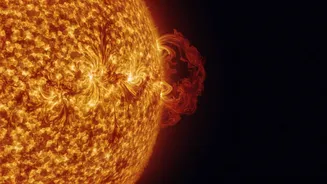
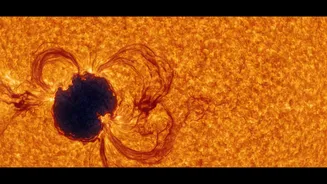
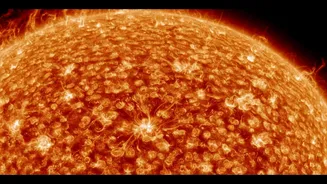
The images, which look like golden caramel or close-ups of abstract metalwork, show the sun’s photosphere in unprecedented detail. What you are seeing is a pattern of turbulent, boiling gas that covers the entire star. The surface is made up of countless
individual cells, known as granules, which are the signature of violent convective motions. Each of these cell-like structures is roughly the size of Texas, making them colossal by any Earthly standard. In this process, hot solar plasma rises in the bright centers of the granules, cools, and then sinks back below the surface along the dark lanes that separate them. It’s a seething, constantly churning process that transports heat from the sun's deep interior to its surface. For the first time, scientists can resolve features as small as 20-30 kilometers across, a level of detail that was previously impossible.
The Eye on the Sun
While the headline mentions NASA, and the agency is a key player in solar science, these record-breaking images come from the National Science Foundation's (NSF) Daniel K. Inouye Solar Telescope. Perched atop Haleakalā on the island of Maui, Hawaii, it is the largest and most powerful solar telescope in the world. Its massive four-meter primary mirror allows it to collect more sunlight and see finer details than any other ground-based instrument. These new observations, some of which were published in the journal Nature in August 2026, are helping scientists test theories that have existed for over a century. The telescope provides the resolution needed to see the fundamental physics of our star in action, validating long-held hypotheses about its behavior.
Unlocking Magnetic Secrets
These images are far more than just pretty pictures; they are a goldmine of scientific data. For the first time, observers have confirmed the existence of a phenomenon called Kelvin-Helmholtz instability on the sun's surface. This occurs when two fluids, in this case streams of superheated plasma, move past each other at different speeds, creating distinctive swirling vortices. These tiny whirlpools and the newly visible fine, thread-like magnetic 'stripes' along granule edges are believed to play a key role in how energy moves around the sun. Scientists theorize that these small-scale dynamics could be one of the keys to solving a major solar mystery: why the sun’s outer atmosphere, the corona, is millions of degrees hotter than its surface, which is only about 6,000 degrees Celsius.
Why This Matters for Us on Earth
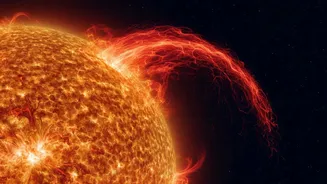
Understanding the sun’s complex magnetic behavior is crucial for predicting space weather. The sun frequently releases massive bursts of energy and charged particles, known as solar flares and coronal mass ejections (CMEs). When these energetic blasts are aimed at Earth, they can cause geomagnetic storms that have the potential to disrupt our modern way of life. These storms can damage satellites, scramble GPS navigation, and even overwhelm electrical power grids, causing widespread blackouts. By studying the fine-scale magnetic fields and plasma flows revealed in these new images, scientists hope to improve their models for forecasting these events. Better predictions would give us more time to protect our critical infrastructure, essentially creating a more reliable weather forecast for space.