

A Cosmic Lion's Roar
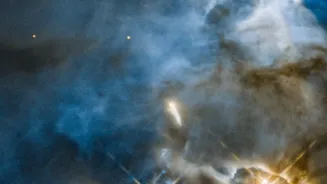
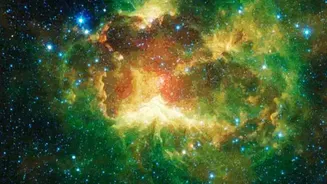
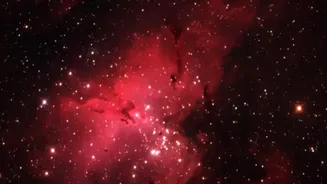
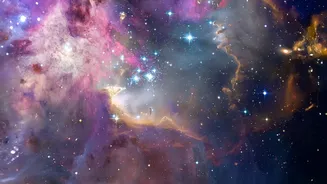
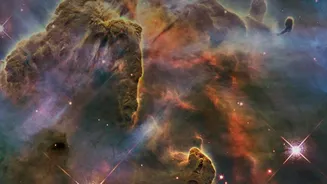
The latest celestial showstopper from the James Webb Space Telescope (JWST) is a stunning new image of a vast stellar nursery nicknamed the Lion Nebula. Properly known as Sharpless 132 (Sh2-132), this colossal cloud of gas and dust, located about 10,000
light-years away, sprawls across the cosmos. Previous telescopes have viewed this region, but Webb’s powerful infrared vision cuts through the obscuring dust to reveal the nebula’s inner workings with astonishing clarity. The image glows with ethereal light, showcasing immense cavities carved out by powerful radiation, dense filaments of cosmic dust where new stars are forming, and the brilliant light of massive, young stars that dominate the scene. It’s a dramatic and dynamic environment, a snapshot of creation on a galactic scale.
Webb's Infrared Superpower
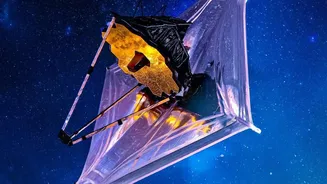
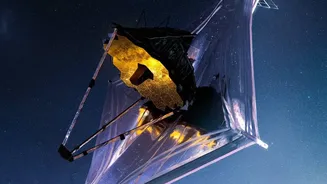
So, how does Webb capture such incredible detail where other telescopes see only murky clouds? The secret lies in its ability to see the universe in infrared light. Stellar nurseries like the Lion Nebula are thick with cosmic dust, which acts like a dense fog, blocking visible light from escaping. This is why telescopes like Hubble, which primarily observe in visible and ultraviolet light, can’t peer deep inside. Webb, however, is designed to detect the longer wavelengths of infrared light. This light can pass through the dense dust clouds, allowing the telescope to see the faint heat signatures of protostars—infant stars still gathering mass—and other structures hidden within. Webb’s Near-Infrared Camera (NIRCam) and Mid-Infrared Instrument (MIRI) work together to piece together a complete picture, revealing both the glowing gas and the cooler, denser dust that are the raw ingredients for new stars.
The Science of a Stellar Nursery
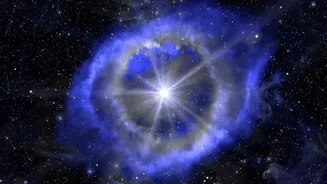
A stellar nursery is exactly what it sounds like: a place where stars are born. These regions are vast, cold clouds of molecular hydrogen and dust. Within these clouds, gravity begins to pull material together into denser clumps. As a clump collapses under its own weight, the core heats up, forming a protostar. This infant star isn't yet hot enough to trigger nuclear fusion like our sun, but it furiously pulls in surrounding gas and dust, growing in mass over hundreds of thousands of years. The new Webb image of the Lion Nebula showcases this process in action. We can see the intense radiation and powerful stellar winds from the most massive young stars in the region—known as O-type and B-type stars, as well as extremely volatile Wolf-Rayet stars—blowing enormous bubbles in the surrounding gas. This outflow clears away material, but it can also compress nearby gas and dust, triggering a fresh wave of star formation.
From Cosmic Dust to New Worlds
What makes Webb’s observations so revolutionary is their ability to reveal not just the birth of stars, but the very beginnings of planetary systems. As a protostar forms, the leftover material flattens into a rotating disc around it, known as a protoplanetary disk. It is within these disks that planets, asteroids, and comets eventually take shape. Webb’s instruments are sensitive enough to detect the chemical makeup of these disks, identifying water, carbon dioxide, and even complex organic molecules. These are the fundamental building blocks for rocky, Earth-like planets. By studying active star-forming regions like the Lion Nebula, astronomers are essentially watching a replay of our own solar system's origin story. The processes unfolding 10,000 light-years away are the same ones that formed our sun and Earth billions of years ago, offering profound clues about our own cosmic ancestry.