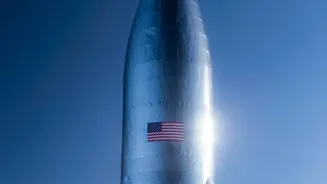






In a landmark achievement for reusable rocketry, SpaceX has successfully caught its Starship spacecraft using mechanical arms on its launch tower. This feat, long considered a holy grail of spaceflight, promises to revolutionize the economics of accessing
space.
A Historic Moment in Texas
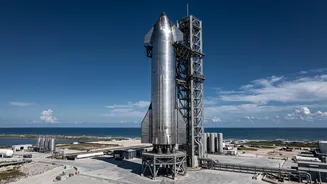
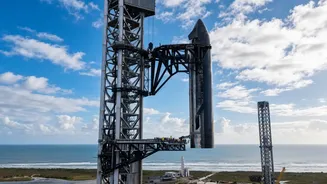
On Saturday, November 14, 2026, after a 22.5-hour orbital mission, the Starship upper stage descended through the Texas sky. The 15th test flight of the massive rocket system concluded with a manoeuvre that looked like something out of science fiction. After surviving the intense heat of atmospheric reentry, the vehicle performed a 'belly flop' descent before reorienting itself vertically. It then slowed to a hover and slipped precisely between the two giant 'chopstick' arms of the launch tower, known as 'Mechazilla', which closed around it to complete the first-ever tower catch of an orbital spacecraft.
What is the Tower Catch?
The tower catch is a daring engineering solution designed for full and rapid reusability. Instead of landing on legs, the returning rocket stage flies directly back to the launch mount. The massive launch tower, which is used to stack the rocket before launch, is equipped with two huge, robotic arms. These arms are designed to grab the descending vehicle in mid-air and place it back on the mount, ready for inspection and its next flight. The manoeuvre requires incredible precision, coordinating the vehicle's final engine burns and flight controls with the movement of the ground-based arms to meet at an exact point in space and time.
The Quest for Rapid Reusability
Catching the rocket is about more than just a dramatic recovery. The primary goal is to make spaceflight cheaper and more frequent, similar to how commercial airlines operate. By eliminating landing legs, the rocket saves a significant amount of weight, which can be converted into more payload capacity. It also removes complex systems that could fail. Most importantly, catching the vehicle directly on the launch mount drastically cuts down the turnaround time. There is no need for cranes or transport vehicles to move the rocket from a separate landing zone. SpaceX's vision is to catch, refuel, and relaunch a Starship within hours, a pace that would fundamentally change access to space.
A Partially Successful Mission
While the catch of the Starship upper stage was a resounding success, Flight 15 was not without its challenges. The mission plan originally called for a historic 'double catch', with the Super Heavy booster also returning to be caught by the tower shortly after launch. However, the booster experienced an issue, reportedly a low fuel warning, and its automated safety systems diverted it for a splashdown in the Gulf of Mexico, where it was lost. This was a setback, as SpaceX has successfully caught the Super Heavy booster on three previous flights, but it did not overshadow the main achievement. During its time in orbit, the spacecraft also successfully deployed 26 Starlink satellites.
What This Means for the Future
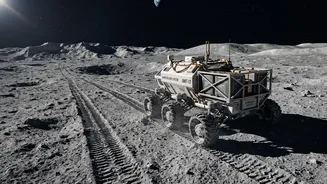
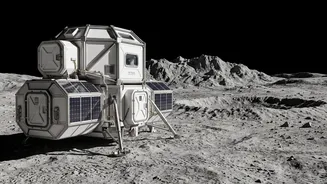
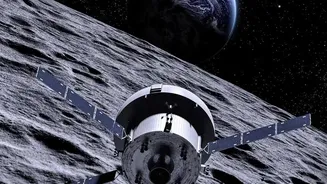
This successful catch is a critical step in SpaceX's ambitious plans. Starship is the vehicle NASA is counting on to land astronauts on the Moon for its Artemis program. For SpaceX CEO Elon Musk, however, the Moon is just a stepping stone. His ultimate goal is to use a fleet of rapidly reusable Starships to build a self-sustaining city on Mars, making humanity a multi-planetary species. Achieving airplane-like reusability is the key to making that vision economically viable. This single catch, while monumental, is one of many steps. The company will need to repeat the feat consistently with both the ship and booster to prove the system is reliable for crewed missions and the high-frequency launch schedule it envisions.