





The Problem with Spheres
For years, scientists planning planetary defence strategies faced a major hurdle. To simulate deflecting an asteroid, their computer models often had to make a big assumption: that asteroids are perfect spheres. Physicist Nathan Moore of Sandia National
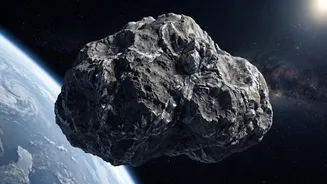
Laboratories notes that this simplification makes the complex calculations manageable for computers. The trouble is, as Moore plainly states, 'spherical asteroids don't exist'. Real asteroids are lumpy, potato-shaped, and irregular, ranging from solid rocks to loose collections of rubble held together by gravity. This meant that while older simulations were useful, they were based on a fundamentally flawed premise. Predicting the effect of a kinetic impactor (like NASA’s DART mission) or a standoff nuclear blast was an educated guess at best, as the shape drastically changes the outcome.
Why Asteroid Shape Is Critical
Imagine trying to push a perfectly round ball versus an awkwardly shaped piece of furniture. The ball moves predictably, but the furniture might spin, tumble, or slide in an unexpected direction. The same principle applies to asteroids. An irregular surface, with its unique collection of ridges, craters, and slopes, complicates how energy is transferred to the object. A blast of X-rays from a nearby detonation, one proposed deflection method, would heat the surface and cause material to vaporise and escape, creating a push. On a lumpy asteroid, where that push is applied matters immensely. Sandia's new research shows just how much. For one simulated asteroid, hitting it from one angle produced a deflection velocity nearly five times greater than hitting it from another. On a different simulated asteroid, the change in its spin varied by a factor of 17 depending on where it was hit. Aiming carefully isn't just a good idea; it's the difference between success and failure.
A Faster, Smarter Model
The breakthrough at Sandia was creating a model that didn't have to choose between realistic shapes and high-fidelity physics. Previously, combining both was too computationally expensive. The new algorithm developed by Moore and his team, however, is over 1,600 times faster. This speed allows researchers to finally tackle the problem with the detail it deserves. The team cleverly combined two existing Sandia simulation programs that are usually used for opposite problems. The 'ALEGRA' code is built for modelling fast, high-energy events, while the 'SPARTA' code models weaker, slowly evolving forces like the drag on a satellite. By figuring out how to make these two codes work together, they created the most accurate and detailed asteroid deflection model to date.
From Theory to a Practical Tool
This new model acts as a powerful planning tool. Scientists can now upload high-resolution 3D imagery of a real asteroid, captured by a spacecraft flyby, and run a series of virtual tests. They can simulate an X-ray burst and adjust its power, its distance from the asteroid, and the angle of attack. The program generates a heat map showing which parts of the surface vaporise, and from that, it calculates the push, the resulting spin, and how much the surface might break apart. This last point is crucial. The goal of a deflection mission is to nudge the asteroid off its collision course, not shatter it into a cloud of smaller, but still potentially deadly, pieces. While the current model excels at predicting surface damage, Moore notes that predicting the breakup of the entire asteroid body is a future goal.
What This Means for Earth's Defence
While a kinetic impactor like DART is a proven method, standoff nuclear devices are considered a vital last-resort option, especially for very large asteroids or those discovered with little warning time. This new simulation capability transforms our ability to plan for such a contingency. Instead of relying on generalised estimates, mission planners could use this tool to calculate the optimal explosive strength and targeting strategy for a specific, known threat. Of course, limitations remain. The model requires detailed data on the asteroid's shape, which may be hard to get in a time crunch. Furthermore, actually positioning an explosive device at the perfect spot next to a fast moving object in space is a monumental engineering challenge. However, this research represents a significant leap from guesswork to data driven strategy than greatly improving our chances of being prepared for a doomsday scenario.