



The Incredible Journey So Far
Cast your mind back to 2015. That was the year New Horizons stunned the world with the first-ever close-up images of Pluto, revealing a complex world of nitrogen ice glaciers, towering water-ice mountains, and a surprisingly youthful surface. Four years
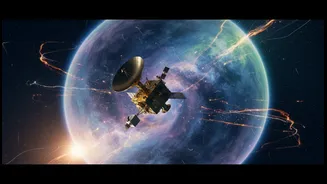
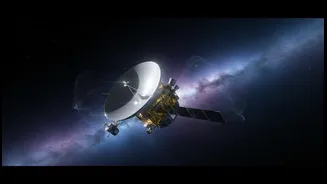
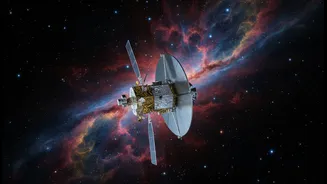
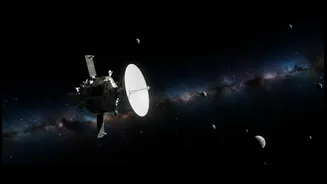
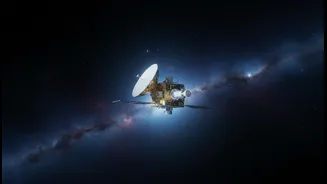
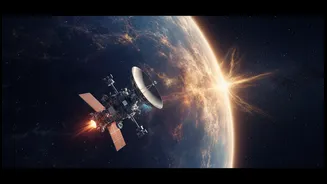
later, it broke another record by visiting Arrokoth, the most distant and primitive object ever explored by a spacecraft. Since then, the little probe has been cruising through the Kuiper Belt, a vast, icy debris field beyond Neptune’s orbit. As of mid-2026, it is nearly 9.5 billion kilometres from Earth, dutifully collecting data on its lonely voyage. It travels at such an immense speed that it covers about 480 million kilometres each year. Its primary mission objectives are long complete, but its journey is far from over. New Horizons is now a deep-space observatory, our sole robotic outpost in this remote region of space, with its sights set on an even bigger prize: interstellar space.
Our Sun's Protective Bubble
The solar system isn’t just a collection of planets orbiting the Sun in empty space. The Sun constantly spews a stream of charged particles, called the solar wind, in all directions. This supersonic wind creates a massive magnetic bubble around our entire solar system, known as the heliosphere. This bubble acts as a cosmic shield, deflecting a significant amount of high-energy galactic cosmic rays that originate from supernova explosions and other violent events in the Milky Way. Without this protective bubble, life on Earth would be far more exposed to damaging radiation. The heliosphere extends far beyond the orbits of the planets, forming a boundary where our Sun's influence finally gives way to the vast expanse of interstellar space—the space between the stars. Think of it like a boat moving through water, creating a wake. The heliosphere is the wake created by our Sun as it travels through the galaxy.
Approaching the 'Termination Shock'
The edge of the heliosphere isn't a simple line. It's a complex, multi-layered boundary. The first key landmark New Horizons is expected to cross is called the “termination shock.” This is the point where the solar wind, which has been traveling at supersonic speeds for billions of kilometres, abruptly slows down as it begins to interact with the interstellar medium. It’s like a traffic jam on a cosmic highway. Beyond this lies a turbulent region called the heliosheath, and finally, the heliopause—the true outer boundary where the solar wind is stopped entirely. Only two active spacecraft, NASA’s legendary Voyager 1 and 2 probes, have ever crossed this frontier. They found that the heliosphere is not a perfect sphere; its shape and size change with the Sun’s 11-year activity cycle. During periods of high solar activity, the bubble expands; during quiet times, it contracts.
A Date with the Frontier
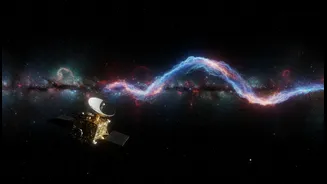
So, when will New Horizons reach this boundary? The headline's use of "may" is important. Because the heliosphere breathes in and out, pinning down an exact date is tricky. However, recent studies using advanced solar wind forecasting models have provided a window. Scientists predict New Horizons will encounter the termination shock sometime between 2029 and 2040. This wide timeframe accounts for the unpredictable push and pull of the solar cycle. It's even possible the probe could cross the boundary more than once as the heliosphere expands and contracts around it. Mission planners are preparing for this encounter, ensuring the spacecraft is ready to take critical measurements when it arrives. Each bit of data will be invaluable, as we have only had two probes make this crossing before.
What We Hope to Learn
While the Voyager probes were groundbreaking pioneers, they were launched in 1977 with technology from that era. New Horizons, launched in 2006, carries a more modern and sensitive suite of instruments. Its plasma and dust detectors can provide a much clearer picture of this mysterious region. Crucially, Voyager 1's plasma instrument, which measures the density, temperature, and speed of the solar wind, was no longer functioning when it crossed into interstellar space. This left a significant gap in our understanding. New Horizons will be able to make those measurements, providing the first direct look at how the plasma behaves as it transitions from the Sun's domain to the galaxy's. By combining its future data with the legacy of Voyager, scientists will be able to build a far more complete model of our solar system's shield and how it interacts with the galaxy around it.