
Our Sun’s Protective Bubble
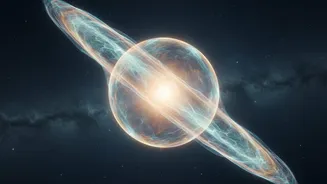
Imagine our solar system moving through the Milky Way galaxy. The Sun constantly releases a stream of charged particles called the solar wind. This wind travels outward at supersonic speeds, pushing against the gas and dust of interstellar space. This creates
a massive bubble, known as the heliosphere, with our solar system inside. The edge of this bubble, the heliopause, is the literal boundary where the Sun’s influence ends and interstellar space begins. This boundary is vital; it acts as a shield, deflecting a significant amount of harmful galactic cosmic rays that could otherwise bombard planets, including Earth. Without it, space travel would be far more dangerous, and the conditions for life might be very different.
Meet NASA’s New Cosmic Cartographer
Enter the Interstellar Mapping and Acceleration Probe, or IMAP. Launched in late 2025, this spacecraft is not journeying to the edge of the solar system itself. Instead, it is cleverly positioned about 1.5 million kilometers from Earth towards the Sun. From this vantage point, it acts like a cosmic cartographer. IMAP’s suite of ten advanced instruments is designed to detect special particles called Energetic Neutral Atoms (ENAs). These ENAs are created at the distant heliopause when hot solar wind particles collide with cold interstellar atoms. Because they are neutral, they are not affected by magnetic fields and travel in a straight line all the way back to IMAP’s detectors. By tracing their paths, scientists can build a comprehensive, 3D map of the entire heliosphere boundary.
First Glimpses from the Frontier
The first public science data from IMAP, released this week, provides our most detailed look yet at this invisible shield. While the mission's primary science phase officially began in early 2026, these initial results are already transforming our understanding. The new maps reveal the shape and structure of the heliosphere with stunning clarity, confirming some theories while challenging others. For instance, the data gives us a clearer picture of how the solar wind’s ever-changing pressure sculpts the boundary, causing it to ripple and shift. This is a global view that was previously impossible to obtain, giving context to the point-specific data we have from other sources.
Building on the Voyager Legacy
Before IMAP, our only direct information from this region came from the legendary Voyager 1 and Voyager 2 probes. These intrepid explorers physically crossed the heliopause in 2012 and 2018, respectively, and are now journeying through interstellar space. They gave us our first “taste” of what lies beyond, confirming the drastic change in environment. However, they could only measure conditions at their exact locations. IMAP's data complements the Voyagers' findings perfectly. While the Voyager probes provided the ground truth by dipping their toes in the interstellar ocean, IMAP is now providing the full satellite map of the entire coastline, showing how it all connects.
Why This Cosmic Map Matters
This isn't just an academic exercise in map-making. A better understanding of the heliosphere has profound practical implications. As humanity looks to send astronauts deeper into space, including missions to Mars and beyond, knowing how this natural shield works is critical for predicting radiation exposure and keeping them safe. Furthermore, IMAP also functions as an advanced space weather monitor, providing real-time data on solar wind conditions that can affect satellites, power grids, and communications on Earth. This first data release is just the beginning of a new era in understanding our home’s place in the galaxy.