



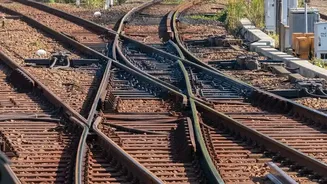

A Challenge of Steep Inclines
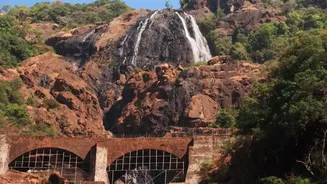
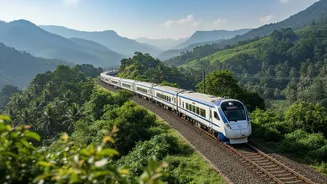
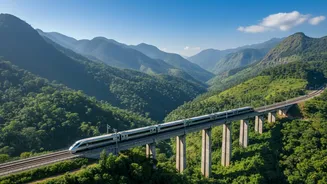
The primary challenge of the Western Ghats lies in its topography. Railway lines here, like the famed Kasara Ghat and the Sakleshpur-Subrahmanya Road section, feature some of the steepest gradients on India's broad-gauge network. A gradient of 1 in 37,
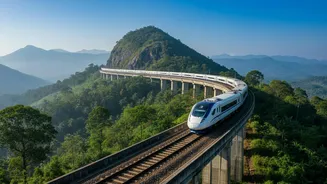
for example, means the track rises one metre for every 37 metres of horizontal distance. For any train, ascending such a slope demands immense power. For the Vande Bharat, a self-propelled trainset without a separate locomotive, this means its distributed power system, with motors in multiple coaches, must work in perfect sync to provide the necessary traction. However, the real test comes during the descent. Gravity relentlessly pulls the train downwards, putting enormous strain on the braking systems to maintain a safe and controlled speed. Unlike conventional trains that often use additional 'banker' locomotives for pushing and braking assistance, the Vande Bharat must rely entirely on its own integrated systems.
The Monsoon Factor
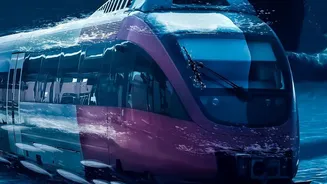
Compounding the challenge of steep slopes is the region's intense monsoon season. The Western Ghats receive some of the heaviest rainfall in the country, which transforms the railway environment. Tracks become slippery, drastically reducing the adhesion between the wheels and the rails. This makes braking more complex, as the wheels are more prone to locking and sliding. Furthermore, the torrential rain increases the risk of landslides and rockfalls, which can obstruct tracks with little warning. Train services have been disrupted for days at a time due to such events. The constant downpour and mist also reduce visibility for pilots, making it even more critical for the train's automated systems to function flawlessly. Operating in these conditions is not just about engineering; it's about battling an unpredictable and powerful force of nature.
Braking Systems Under Scrutiny
The Vande Bharat is equipped with a sophisticated electro-pneumatic braking system, supplemented by regenerative braking where the motors act as generators to slow the train down and feed power back to the grid. On long, steep descents, continuous braking is required. In older trains, this can cause brake pads and wheels to overheat, reducing their effectiveness and posing a safety risk. The Vande Bharat's advanced system is designed to manage this heat and provide consistent stopping power. However, the relentless gradients of the Ghats provide a real-world stress test that goes beyond simulations. To enhance safety on these critical sections, Indian Railways has been conducting trials with Vande Bharat rakes specially equipped with an Automatic Emergency Braking (AEB) system. This technology monitors the train's speed and can automatically apply the brakes if it exceeds the permitted limit on a downward slope, adding a crucial layer of protection.
The Question of Stability
Beyond the straight inclines, the Ghat sections are characterised by hundreds of sharp curves. As a train navigates a curve at speed, it is subjected to powerful lateral forces that can affect passenger comfort and, in extreme cases, stability. The Vande Bharat boasts a superior suspension system and body design to counteract these forces, famously demonstrated in stability tests where a glass of water remains steady at high speed. However, the combination of sharp curves and steep gradients in the Ghats presents a unique dynamic. The train's suspension must manage both vertical forces from the gradient and lateral forces from the curves simultaneously. Recent trials on the Bengaluru-Mangaluru route, which has 108 sharp curves in one 55-km stretch, are specifically designed to evaluate the train's stability and overall performance in these demanding, real-world conditions before regular services can be launched.