





The Two Main Reasons for Change
When a star’s brightness appears to change in a regular cycle, it's typically for one of two major reasons. The first type are 'intrinsic variables', where the star itself is physically changing. Think of it like a cosmic lung, breathing in and out. The second
type are 'extrinsic variables', where the change in brightness is caused by something outside the star, such as another star passing in front of it and blocking its light from our view.
Intrinsic Variables: The Pulsating Stars
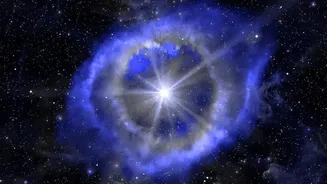
The most famous intrinsic variables are pulsating stars, like Cepheid variables. These are typically giant yellow stars, many times more massive and thousands of times more luminous than our Sun. They are in an unstable phase of their life where they physically swell and shrink. As the star expands, its surface cools and it becomes dimmer. Then, as gravity pulls it back inward, it shrinks, heats up, and becomes brighter. This rhythmic pulsation is incredibly regular, with cycles, or 'periods', lasting anywhere from a few days to several weeks.
A Breakthrough Discovery
In the early 1900s, an astronomer named Henrietta Swan Leavitt made a monumental discovery while studying thousands of variable stars. She found a clear and direct relationship: the longer a Cepheid's pulsation period, the greater its true, intrinsic brightness. This is known as the period-luminosity relationship, or 'Leavitt's Law'. Before this, astronomers could see how bright a star appeared from Earth, but had no way of knowing its actual luminosity, which is crucial for determining its distance.
Cosmic Lighthouses for Measurement
Leavitt’s discovery turned these pulsating stars into one of the most important tools in astronomy. Because a Cepheid's period directly reveals its true brightness, astronomers can use them as 'standard candles'. By comparing a Cepheid's known intrinsic brightness to its apparent brightness as seen from Earth, they can calculate its distance with remarkable accuracy. This technique was revolutionary, allowing Edwin Hubble to prove that the Andromeda 'nebula' was actually a separate galaxy far beyond our own, fundamentally changing our understanding of the universe's vast scale.
Extrinsic Variables: A Celestial Eclipse
The other main reason for regular dimming is found in 'eclipsing binary' systems. More than half of all stars are thought to exist in pairs, orbiting a common center of gravity. If the orbital plane of one of these binary systems is aligned just right with our line of sight from Earth, one star will periodically pass in front of its companion, causing an eclipse. When the dimmer star blocks the brighter one, we see a significant dip in the system's total light. A smaller, secondary dip may occur when the brighter star passes in front of the dimmer one. The famous star Algol, whose name means the 'blinking demon', is a well-known example of an eclipsing binary, dimming predictably every 2.9 days.
More Than Just a Light Show
While pulsating stars and eclipsing binaries are the most common cyclic variables, they are not the only ones. Stars like RR Lyrae variables are similar to Cepheids but older and dimmer, often used to measure distances within our own galaxy. By studying the light curves—the graphs of brightness over time—of all these different variable stars, astronomers can deduce incredible amounts of information. They can determine the mass, size, temperature, and even the age and evolutionary stage of stars, providing crucial insights into the life cycle of stars across the cosmos.