





The Most Obvious Reason: A Convenient Handle
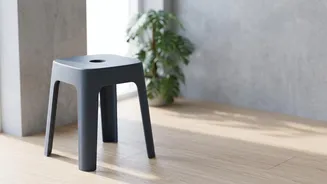
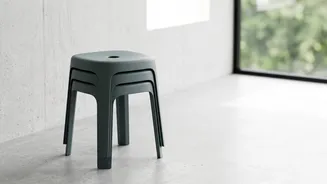
Let’s get the most common assumption out of the way first. Yes, the hole does serve as a convenient handle. It allows you to easily slip your fingers through to pick up and carry the stool. A grip point near the center of gravity makes moving it around
much more stable and comfortable than grabbing it by the edge. This is especially useful in settings like shops, event spaces, and homes where these stools are frequently moved and rearranged. While this is a valid function, it is far from the only reason—or even the most important one.
The Physics of Stacking: Preventing a Vacuum Lock
Here is where the design gets truly clever. Plastic stools are made to be stacked to save space. If the seat were a solid, flat surface, stacking them tightly would trap air between each stool. When you tried to pull the top stool off, the trapped air would create a pressure difference, resulting in a vacuum effect that could make the stools incredibly difficult to separate. The hole acts as a vent, allowing air to pass through freely as you stack and unstack them. This simple feature prevents suction and ensures that anyone can easily grab a stool from the pile without a struggle.
Strength and Durability: The Importance of Shape
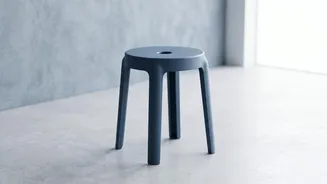
It might seem counterintuitive that removing material could be related to strength, but the hole plays a role in the stool's structural integrity. The key is its shape. Most of these holes are circular. A round hole helps to distribute weight and stress evenly across the surface when someone sits down. If the hole were a square or any other shape with sharp corners, those angles would become stress concentration points. Over time, the force would focus on these weak spots, increasing the risk of the plastic cracking or breaking. A circular design avoids this, contributing to the stool's overall durability.
Practicality in Any Weather: A Path for Drainage
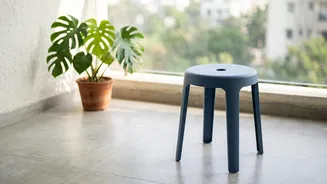
Plastic stools are often used outdoors on balconies, in gardens, or at roadside stalls. They are also used in bathrooms and are frequently washed. Without a hole, rainwater or cleaning water would pool on the seat surface, making it unusable until it was wiped down or evaporated. The hole provides a simple and effective drainage route, allowing liquid to pass straight through. This ensures the stool dries quickly and is ready for use, making it a far more practical choice for all-weather environments.
Smarter Manufacturing: Saving Material and Money
In the world of mass production, every little bit of material saved makes a difference. While the amount of plastic removed to create the hole in a single stool is tiny, it adds up to significant savings when millions of stools are being manufactured. Using less material not only reduces production costs but also makes the final product slightly lighter, which is beneficial for shipping and handling. Some have also noted that the hole can play a part in the injection-molding process, helping to manage how the plastic cools and preventing warping.