


The Astronaut's Dilemma
Imagine being on a three-year mission to Mars. Every kilogram of cargo is meticulously planned and costs a fortune to launch into space. A significant portion of that weight is food and water. Astronauts also produce waste, which takes up valuable space. This
presents a massive logistical problem for space agencies like NASA and the European Space Agency (ESA). To make deep-space exploration feasible, astronauts need a way to live off the land, or in this case, off the spacecraft. The solution they are developing is the ultimate form of recycling: a closed-loop system where human waste, CO2, and even plastics can be converted into breathable air, drinkable water, and edible food.
Nature's Tiny Chefs
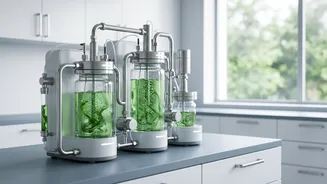
This isn't about directly eating treated sewage. The process is far more sophisticated, relying on microorganisms as microscopic chefs. One prominent project is MELiSSA (Micro-Ecological Life Support System Alternative) by the ESA, which has been in development for over 30 years. It uses a series of bioreactors—tanks where biological reactions happen under controlled conditions—to break down waste. In the first stages, bacteria digest organic waste, much like in our own digestive systems. This produces nutrients and gases. In later stages, other microbes or algae, like Spirulina, consume these outputs. For example, research at Penn State University showed that methane produced during waste digestion could be used to grow a microbe called Methylococcus capsulatus, which is composed of 52% protein and 36% fats. The end product is a nutrient-rich biomass, often described as a 'microbial goo' with a consistency similar to yeast spreads like Marmite.
From Mars Missions to Earthly Markets
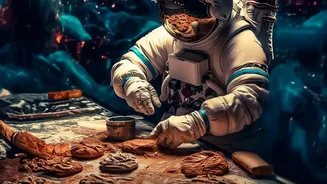
While the initial goal is to sustain life in space, the real game-changer could be its application on Earth. The technology represents a powerful example of a circular economy, where waste is not an endpoint but a resource. Startups and researchers are already exploring how to apply these principles. A Swedish company called Simply No Waste is using microbial fermentation to turn fruit and vegetable side-streams into ingredients for the food and cosmetic industries. Another project at Southern Illinois University, funded by a NASA challenge, is using programmed yeasts to convert plastic waste and agricultural residue into protein-rich cookies extruded by a 3D printer. These systems could be deployed in disaster zones, remote military bases, or even dense urban centres, providing a secure source of nutrition while simultaneously dealing with waste.
Overcoming the 'Yuck' Factor
The most significant hurdle for waste-derived food isn't technological; it's psychological. The 'ick' factor associated with eating anything linked to waste is a major barrier to consumer acceptance. To overcome this, clear communication and demonstrable safety are paramount. Scientists are rigorous about safety, using high temperatures or pH adjustments to eliminate any harmful pathogens from the process. Beyond perception, other challenges include making these systems energy-efficient and scalable. A bioreactor that works perfectly in a lab or a spacecraft needs to be adaptable and affordable to make a real-world impact. Proving that the resulting food is not just safe but also nutritious and palatable is the final, crucial step before any of these innovations can reach a wider market.
A New Frontier for Food Security
For a country like India, which grapples with the dual challenges of managing vast amounts of waste and ensuring food security for a large population, this technology holds immense promise. Globally, about a third of all food produced is lost or wasted, creating not just economic loss but also significant environmental strain. Technologies that upcycle waste into valuable products like food or animal feed could fundamentally reshape our agricultural and urban systems. They offer a path toward reducing landfill dependence, lowering greenhouse gas emissions, and creating new, sustainable industries. This is more than just a clever solution for space travel; it's a potential blueprint for a more resilient and resourceful future on our own planet.