





A Cosmic Neighbor's Secret History
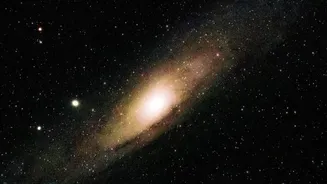
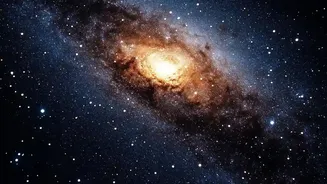
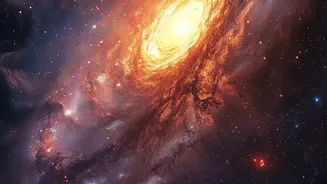
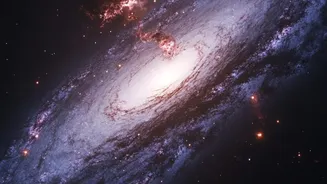
At just 2.5 million light-years away, the Andromeda galaxy is our closest major galactic neighbor and a cosmic sibling to our own Milky Way. Visible to the naked eye as a faint smudge in the night sky, it offers astronomers a unique front-row seat to study
how large spiral galaxies work. For years, scientists have been piecing together its life story, knowing it had a major burst of star formation about two billion years ago. But the latest chapter, courtesy of the Hubble Space Telescope, reveals a different kind of drama: a long, steady decline. A new study shows that over the last 500 million years, Andromeda has been quietly winding down its star-making operations, with a particularly sharp drop in just the last 40 million years.
Reading the Fossil Record of Stars
To uncover this history, astronomers turned to Hubble's unparalleled ability to resolve individual stars from millions of light-years away. The research combined data from two massive surveys—the Panchromatic Hubble Andromeda Treasury (PHAT) and the Panchromatic Hubble Andromeda Southern Treasury (PHAST)—which together mapped two-thirds of the galaxy’s sprawling disk. This effort cataloged roughly 200 million individual stars, which act as a 'fossil record' of the galaxy's past activity. By analyzing the color and brightness of these stars, scientists can determine their age. Massive, hot stars burn blue and die young, indicating recent star birth, while smaller, redder stars live much longer, tracing older populations. This allows researchers to build a detailed, spatially-resolved timeline of when and where stars formed.
The Big Slowdown
The data paints a clear picture of a galaxy taking a breather. 500 million years ago, Andromeda was forming stars at a rate of about one solar mass per year, similar to the current rate in our Milky Way. However, by 40 million years ago, that rate had been cut in half. Today, it has plummeted to just one-fifth of a solar mass per year. This slowdown wasn't uniform across the entire galaxy. Much of the decline is driven by fading activity in a prominent star-forming ring located about 32,000 light-years from the galactic center. This ring was once a hotbed of activity but is now quieting down, dragging the galaxy's overall average down with it. Researchers suggest this isn't because the galaxy ran out of the necessary gas and dust, but is more of a natural winding-down period.
A Likely Suspect?
While much of the slowdown appears to be a natural tapering off after a more active youth, astronomers did notice one localized area of quiet that points to an external influence. The region of Andromeda's disk closest to its small, compact satellite galaxy, M32, showed a more pronounced decrease in star formation that began around 60 million years ago. Scientists have long suspected that M32 may have punched through Andromeda's disk in the past. While the new data doesn't perfectly align with existing timelines for such a collision, the timing of the localized slowdown makes M32 the 'most likely suspect' for disrupting that specific area. However, researchers caution that they cannot yet definitively say M32 is the cause.
A Glimpse into Our Galactic Future
Studying Andromeda’s past is more than just a cosmic history lesson; it's also a glimpse into the future of our own galaxy. The Milky Way and Andromeda are on a collision course, set to merge in about 4.5 billion years. Understanding the life cycle of our neighbor—its bursts of activity, its mergers, and its quiet phases—helps astronomers create more accurate models for how this future cosmic dance will unfold. The detailed census of Andromeda's stars provides an essential benchmark for understanding how large spiral galaxies evolve from active, star-forming systems into quieter ones. This research helps place our own galaxy's evolution in a broader cosmic context and prepares for even deeper investigations with future observatories like the Nancy Grace Roman Space Telescope.