







Plan Your Celestial Shoot
Success in Milky Way photography begins long before you touch your camera. The two most critical factors are location and timing. You need to escape the light pollution of cities and towns by heading to a designated dark-sky area. India has several excellent
spots, including the Hanle Dark Sky Reserve in Ladakh and Pench Tiger Reserve in Maharashtra, which is the country's first Dark Sky Park. Other promising locations include Spiti Valley, the Rann of Kutch, and parts of Coorg. Timing is equally crucial. The bright galactic core of the Milky Way is best viewed in the Northern Hemisphere from February to October. For the darkest skies, plan your trip around the new moon, as even a partial moon can wash out the faint light of the galaxy. Use stargazing apps to track the moon phase and the exact position of the Milky Way in the sky for your chosen dates and location.
Gear Up for the Galaxy
While you don't need a space telescope, specific gear is essential for capturing the stars. The non-negotiables are a camera with manual mode, a wide-angle lens, and a sturdy tripod. A DSLR or mirrorless camera is ideal because it allows you to control the settings needed for long exposures. The lens should be 'fast'—meaning it has a wide aperture (like f/2.8 or lower) to let in as much light as possible. A focal length between 14mm and 24mm is perfect for capturing a sweeping view of the sky. A rock-solid tripod is vital to prevent any camera shake during the long exposure. Other highly recommended items include a remote shutter release or using your camera’s self-timer to avoid vibration, extra batteries (cold nights drain them faster), and a headlamp with a red-light mode to preserve your night vision.
Dial In Your Camera Settings
This is where the magic happens. Switch your camera to Manual (M) mode to take full control. Start with these settings as a baseline: First, set your aperture as wide as it will go (e.g., f/1.8, f/2.8) to gather maximum light. Second, set your shutter speed. A good starting point is between 15 and 20 seconds. Go much longer, and the Earth’s rotation will cause the stars to streak. Third, adjust your ISO, which controls the sensor's sensitivity to light. Begin with an ISO of 3200 or 6400. Finally, switch your lens to manual focus. Point it at the brightest star or planet you can see, use your camera's live view to zoom in digitally, and carefully adjust the focus ring until the star is a sharp, tiny point of light. Shoot in RAW format, as this captures more data and gives you far more flexibility in editing.
Compose Your Cosmic Shot
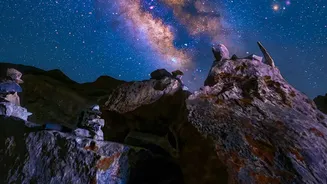
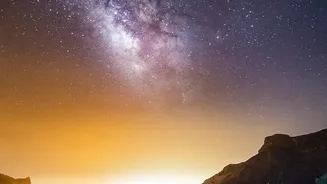
A photo of just stars can be beautiful, but a truly compelling image often includes a piece of the Earth. Before it gets completely dark, scout your location for interesting foreground elements. A lone tree, a mountain silhouette, a still lake, or unique rock formations can add a sense of scale and place, grounding the vastness of the cosmos. Think about how the arc of the Milky Way will interact with your chosen foreground. Will it rise from behind a mountain? Will it be reflected in water? Taking test shots during the day or at dusk can help you finalize your composition without fumbling in the dark. Don't be afraid to experiment with different angles to create a dynamic and memorable image.
The Finishing Touch in Post-Processing
The image straight out of your camera is just the starting point. Post-processing is where your Milky Way photo will truly come to life. Software like Adobe Lightroom or Photoshop is used to enhance the details captured in your RAW file. The initial image might look dark and flat, but the data is all there. Basic adjustments involve increasing exposure, boosting contrast to make the Milky Way pop, and refining the white balance to achieve a natural-looking sky colour. You can also selectively brighten the galactic core, reduce any 'noise' or graininess that appears from the high ISO, and enhance clarity to sharpen the stars. There is no single 'correct' way to edit, so experiment with these sliders to develop your own style and bring your celestial vision to life.