






The Sun We Thought We Knew
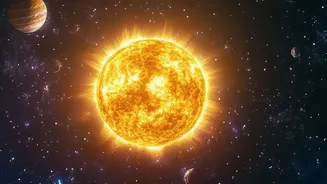
For decades, our understanding of the Sun's energy transfer has been based on a two-part journey. Deep in the core, nuclear fusion generates immense energy. This energy, in the form of photons, begins a long, random walk outward through a dense region
called the radiative zone, a process that can take over 100,000 years. Closer to the surface, in the convective zone, the process speeds up. Here, energy is carried by huge, boiling columns of hot plasma that rise, cool, and sink, much like a pot of boiling water. These massive convection cells, some as large as Texas, create the granular, honeycomb-like pattern we see on the Sun's visible surface, the photosphere. This model has been the bedrock of solar physics, explaining the basic flow of heat from the core to the surface.
A Fresh Look at a Familiar Star
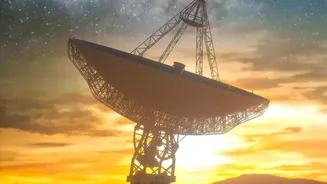
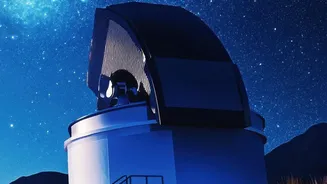
Recent breakthroughs have come from the Daniel K. Inouye Solar Telescope in Hawaii, the world's most powerful solar observatory. Its massive four-meter mirror has allowed scientists to capture the highest-resolution images of the Sun's surface ever taken, resolving features as small as 20 kilometres across. For decades, images of the boundaries between the Sun’s convection cells appeared blurry. Scientists debated whether this was a limitation of their telescopes or a true feature of the Sun. The new images have settled the debate, revealing a level of detail that was previously unimaginable. Instead of fuzzy edges, the telescope showed thousands of tiny, swirling whirlpools of plasma dancing along the magnetic boundaries of the granules.
Unpacking the New Puzzle
These newly observed structures are the first direct confirmation of a phenomenon known as the Kelvin-Helmholtz instability (KHI) on the Sun's photosphere. This effect occurs when two fluids or gases sliding past each other at different speeds create a shear, which curls into vortices. We see this same process in curling ocean waves and wind-swept clouds on Earth, and even in the atmospheres of Jupiter and Saturn. On the Sun, these instabilities are created where hot, rising plasma in the convection cells shears against cooler, sinking plasma and concentrated magnetic fields. The discovery of these tiny but ubiquitous vortices suggests a new, previously unseen mechanism for energy and magnetic field movement on the Sun, operating at a much smaller scale than previously thought.
Rewriting the Solar Playbook
The existence of these vortices raises profound questions and may help solve one of solar physics' most persistent mysteries: the coronal heating problem. The Sun’s outer atmosphere, the corona, is hundreds of times hotter than the visible surface below it, which defies simple thermodynamic logic. Scientists have long suspected that magnetic energy from the surface heats the corona, but the exact mechanism was unclear. These newly found vortices may provide the answer. It is theorised that their constant twisting motion braids the Sun's magnetic field lines, building up tension and storing enormous amounts of energy. When this tension is released, it could power everything from tiny nanoflares to massive coronal mass ejections, contributing significantly to heating the corona. This suggests our models of solar energy transfer have been missing a crucial, small-scale component.
The Next Chapter in Solar Science
This discovery marks a major step forward, but it is also just the beginning. Scientists now have a new, fundamental process to incorporate into their models of the Sun. The next step is to quantify the impact of these vortices. Using automated programs to analyze the vast amounts of data from the Inouye telescope, researchers hope to measure how much energy these structures carry upward and how they influence the Sun's larger magnetic systems. A better understanding of these small-scale drivers has very practical implications. The energy released by the Sun fuels space weather, which can disrupt satellites, GPS navigation, and even power grids on Earth. By observing the fine details that drive these massive events, we can improve our ability to predict space weather and protect our technology.