





Successfully protecting Earth from a dangerous asteroid might be more complex than just hitting it hard. New research reveals that for the lumpy, irregular asteroids that populate our solar system, precision is everything.
The Challenge of Cosmic Billiards
For decades, the concept of planetary
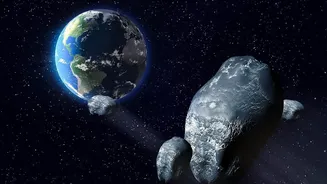
defence has often been simplified to a straightforward idea: spot a threatening asteroid and nudge it off course. One of the leading methods is the 'kinetic impactor' technique, famously tested by NASA's DART mission in 2022. The mission successfully crashed a spacecraft into the small asteroid Dimorphos, altering its orbit and proving the fundamental concept works. Another proposed method involves detonating a nuclear device at a distance, using the resulting X-ray blast to vaporise part of the asteroid's surface. This vaporisation would act like a rocket exhaust, pushing the asteroid onto a new, safer trajectory. However, both concepts have historically relied on a convenient but inaccurate assumption: that asteroids are perfect spheres.
Real Asteroids are Lumpy
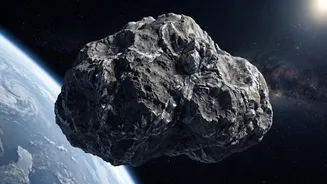
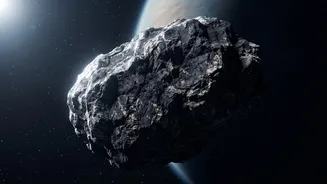
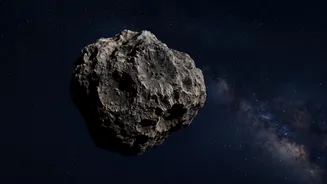
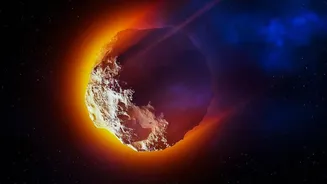
The reality, as confirmed by numerous space missions, is that asteroids are not smooth, round objects. They are often described as 'lumpy' or 'potato-shaped,' with irregular surfaces full of ridges, craters, and valleys. According to Nathan Moore, a physicist at Sandia National Laboratories who led the new research, this detail has been a persistent challenge for scientists. Previous computer models had to choose between using realistic asteroid shapes or performing high-fidelity calculations of the impact physics; doing both was too computationally expensive. This simplification made the math easier but left a critical question unanswered: how does an asteroid’s real, uneven shape affect a deflection attempt?
Sandia's Breakthrough Simulations
Leveraging a new algorithm over 1,600 times faster than previous methods, Moore's team at Sandia developed the most accurate asteroid deflection model to date. They simulated a nuclear X-ray burst on 3D models of real asteroids, including Bennu and Itokawa, and discovered that the point of impact matters enormously. In one simulation, irradiating one side of an asteroid produced a deflection velocity nearly five times greater than hitting another side of the exact same object. The change in the asteroid's spin was even more dramatic, varying by a factor of 17 depending on where the energy was directed. 'We expected aim to matter,' Moore stated. 'What surprised us was how much.'
The High Stakes of a Misfire
These findings highlight a critical risk in planetary defence. A poorly aimed deflection attempt might not just be less effective; it could be a near-total failure. Using five times less force than anticipated could mean the difference between a successful deflection and a catastrophic impact. Moreover, the goal is to gently nudge the asteroid, not shatter it. A miscalculated impact could break the object into multiple large fragments, potentially creating a shotgun-like effect where several pieces could still threaten Earth. While the current Sandia models can predict the breakup of surface rocks, predicting if the entire asteroid body will fracture remains a future research goal.
The Future of Planetary Protection
The key takeaway from Sandia's research is the immense value of reconnaissance. Before attempting to deflect an asteroid, especially using a powerful method like a nuclear burst, we need to know its shape in great detail. This would require sending a probe to survey the object from all sides, creating an accurate 3D model. While this adds a layer of complexity and requires significant warning time, it would allow mission planners to calculate the optimal point of impact for maximum effect and minimal risk. This research doesn't suggest an imminent threat is upon us, but it dramatically refines our understanding of what it would take to protect our planet. It transforms the problem from simply hitting a target to performing a precise cosmic surgery.